
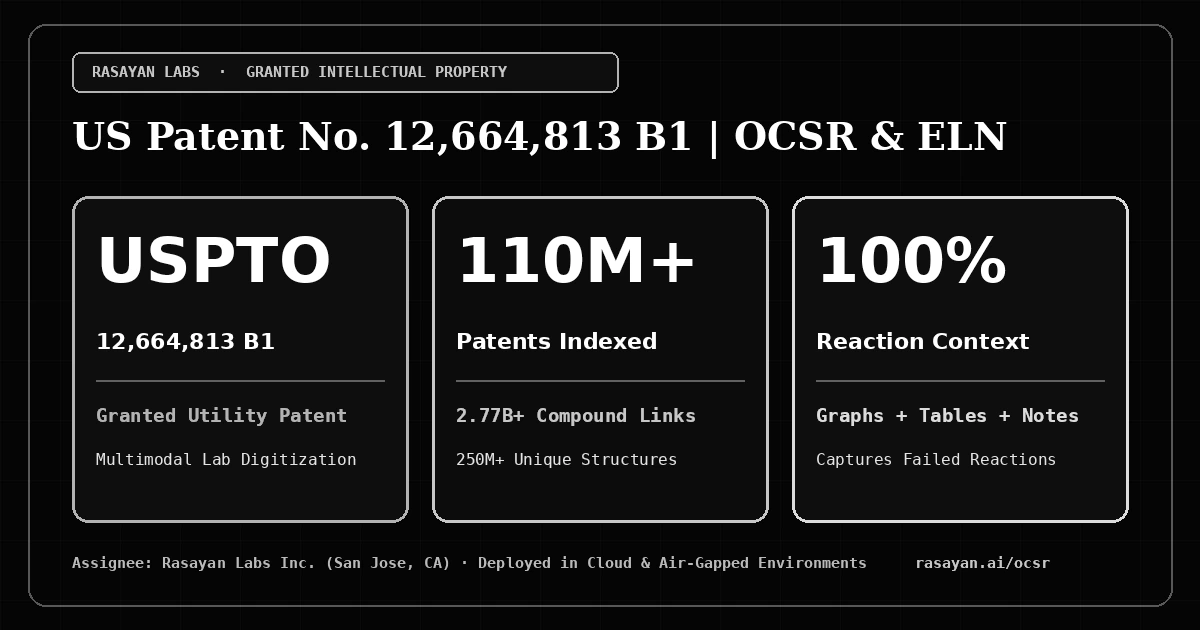
Granted US Patent No. 12,664,813 B1
Powering 110M+ indexed patents, 2.77B+ compound-patent links, and enterprise laboratory archive digitization.
The United States Patent and Trademark Office (USPTO) has granted US Patent No. 12,664,813 B1 to Rasayan Labs Inc., protecting our core multimodal architecture for chemistry-aware document intelligence and handwritten laboratory notebook digitization.
Across pharmaceutical, agrochemical, and specialty chemical enterprises, decades of proprietary experimental records remain locked inside physical laboratory notebooks, scanned PDF batch sheets, and legacy analytical reports. Standard optical character recognition (OCR) software fails on these documents because the essential scientific meaning is encoded in hand-sketched molecular structures, stereochemical wedges, reaction arrows, and cursive marginalia rather than plain body text.
Even more valuable than the successful syntheses recorded in those archives are the negative results: the reaction conditions that produced tar, low yields, or unwanted regioisomers. When historical notebooks remain unsearchable in storage folders, newly hired chemists inevitably waste months repeating failed experiments that a colleague already ran years earlier.
Production Scale Across 110 Million Patents and Enterprise ELN Archives
At global scale, the pipeline protected under US Patent No. 12,664,813 B1 has enabled Rasayan Labs to process more than 110 million patent documents, extracting over 250 million unique canonical chemical structures and constructing a queryable graph of 2.77 billion compound-patent associations.
Inside enterprise laboratory environments, the same architecture ingests skewed, stained, or handwritten notebook pages, resolves hand-drawn reactants and products into valence-validated SMILES, InChI, and MOL V3000 connection tables, and binds each molecule directly to its corresponding stoichiometry row, reaction temperature, and analytical yield.
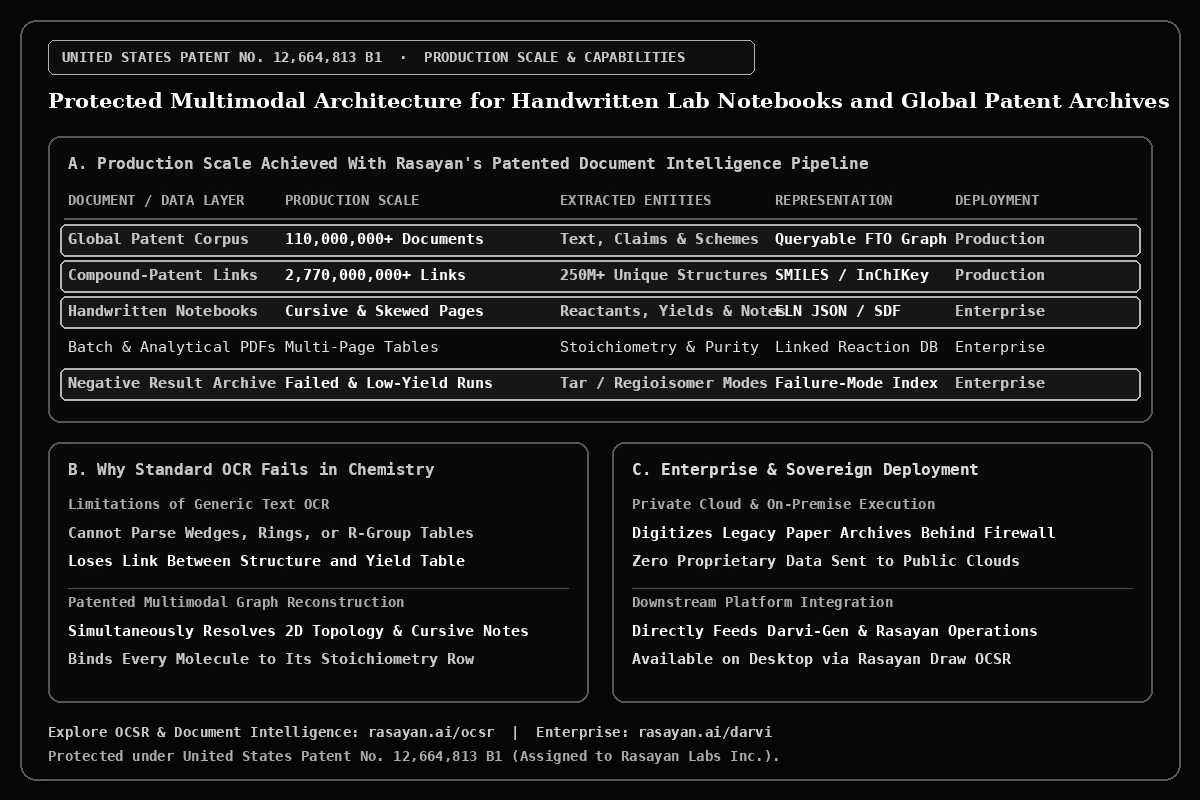
Global Patent & Compound Knowledge Graph (Production Scale)110M+ Patents · 2.77B Links▾
Handwritten Lab Notebook & Legacy Batch Record DigitizationUS Patent 12,664,813 B1▾
How the Patented Multimodal Reconstruction Pipeline Works
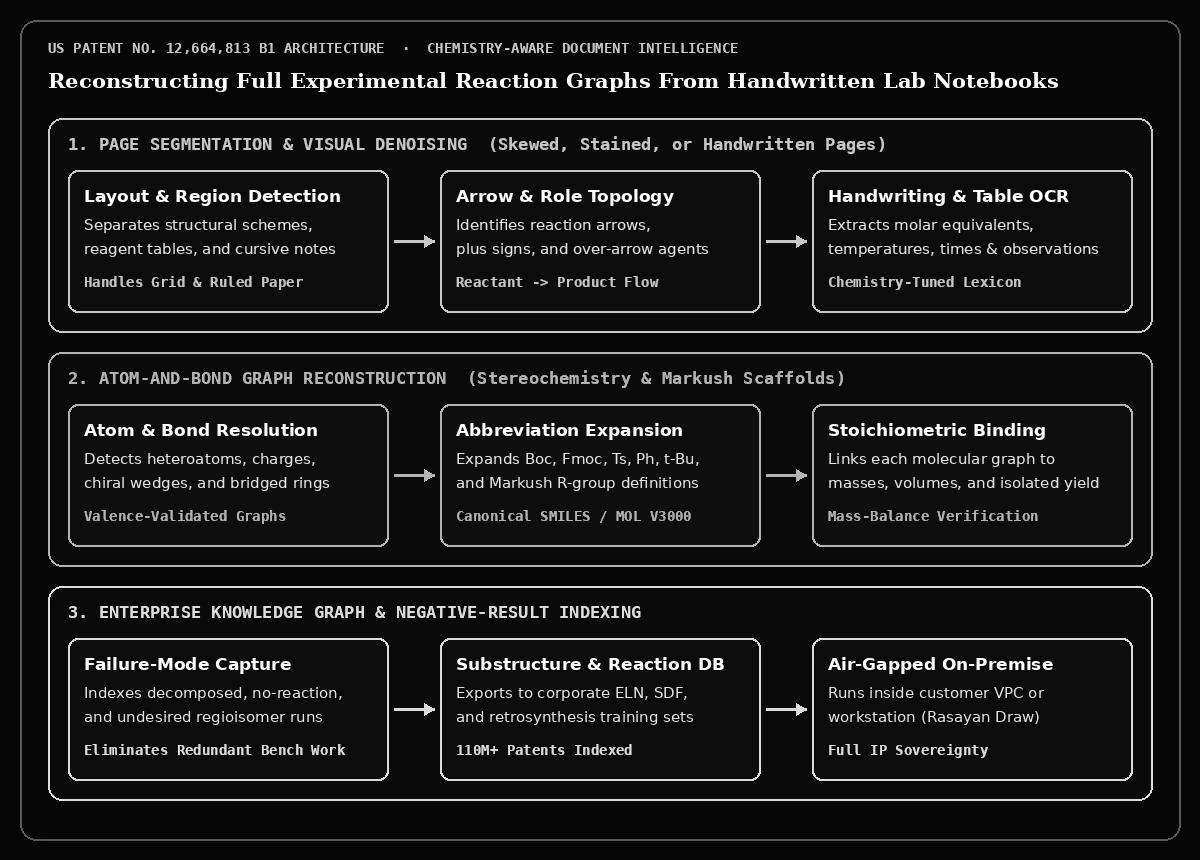
Digitizing a chemistry notebook requires more than recognizing isolated benzene rings. Our patented pipeline executes three coupled stages: (1) visual denoising and layout segmentation on skewed, ruled, or stained pages to separate reaction schemes from reagent tables and handwritten observations; (2) atom-and-bond graph reconstruction with superatom abbreviation expansion (such as Boc, Fmoc, Ts, and Markush R-groups) and chiral wedge resolution; and (3) stoichiometric binding that verifies mass balance between drawn structures and tabular weights.
Sovereign Deployment Inside Enterprise Firewalls
For pharmaceutical and chemical enterprises, our document intelligence pipeline deploys inside private cloud VPCs, air-gapped on-premise servers, or locally on individual Windows workstations via Rasayan Draw, turning decades of paper and PDF archives into a live, substructure-searchable corporate asset.
Explore our technical monographs and documentation, or connect directly with Rasayan Labs.