
Rasayan Labs Takes First Place on CYP Inhibition in the OpenADMET Challenge
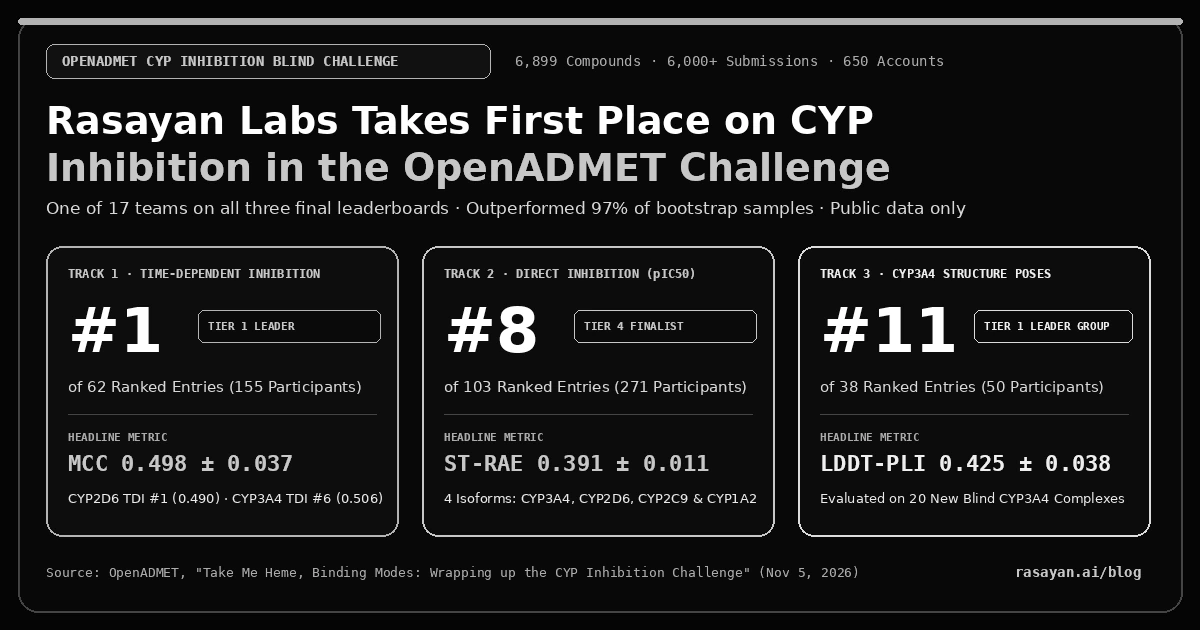
Two months. More than 6,000 submissions. 650 accounts. When OpenADMET closed its CYP Inhibition Blind Challenge on November 3, Rasayan Labs sat at the top of the Time-Dependent Inhibition (TDI) leaderboard.
This post covers why CYP inhibition is worth predicting, how we placed, and one caveat we think every team should read.
Catching CYP liability before synthesis
Chemists already know what a CYP liability costs. The harder part is when it shows up: time-dependent inhibition needs a with-NADPH shift assay, so the answer usually arrives after the compound is made.
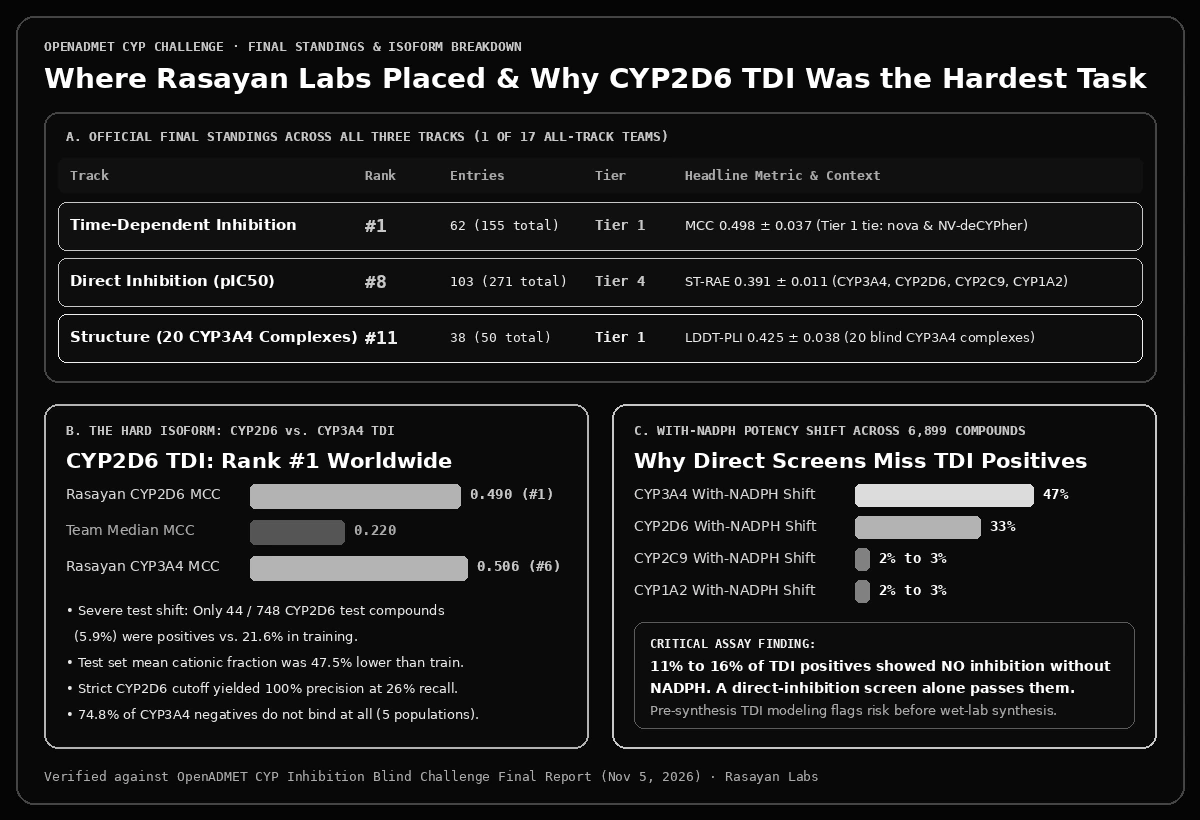
The data makes the case. A potency shift with NADPH appeared in 47% of CYP3A4 and 33% of CYP2D6 compounds, against 2% to 3% for CYP1A2 and CYP2C9. And 11% to 16% of TDI positives showed no inhibition without NADPH, so a direct-inhibition screen alone would have passed them.
A predictive model moves the question from "what did the assay say?" to "should we make this compound?" Chemists can drop likely liabilities before synthesis, weigh lower basicity against oxidizable groups, and save TDI assays for flagged compounds. The assay still confirms, but the warning comes before synthesis, not after.
The challenge
OpenADMET measured inhibition for 6,899 compounds across CYP3A4, CYP2D6, CYP2C9 and CYP1A2, with the test set blind until the deadline. There were three tracks: Direct Inhibition (predict pIC50, 271 participants), Time-Dependent Inhibition (classification, 155) and Structure (poses against 20 new CYP3A4 complexes, 50).
Where Rasayan Labs placed
| Track | Rank | Entries | Tier | Headline metric |
|---|---|---|---|---|
| Time-Dependent Inhibition | 1 | 62 | Tier 1 | MCC 0.498 ± 0.037 |
| Direct Inhibition | 8 | 103 | Tier 4 | ST-RAE 0.391 ± 0.011 |
| Structure | 11 | 38 | Tier 1 | LDDT-PLI 0.425 ± 0.038 |
We were one of 17 teams that appeared on all three final leaderboards. We share Tier 1 in TDI with two other teams, nova and NV-deCYPher, so the fair reading is a statistical tie at the top, with our entry holding the highest score.
Our own bootstrap check points the same way: our CYP entries outperformed 97% of bootstrap samples.
Time-Dependent Inhibition (Rank #1 of 62 · Tier 1 · MCC 0.498 ± 0.037)Rank #1 · Tier 1▾
Direct Inhibition (Rank #8 of 103 · ST-RAE 0.391 ± 0.011)Rank #8 · 4 Isoforms▾
Structure Track (Rank #11 of 38 · Tier 1 · LDDT-PLI 0.425 ± 0.038)Tier 1 · 20 Complexes▾
The hard isoform
CYP2D6 TDI was the hardest task. Only 44 of 748 test compounds (5.9%) were positives, against 21.6% in training, and the test set had a mean cationic fraction 47.5% lower than training. Our model ranked first on this isoform with an MCC of 0.490 against a team median of 0.22. On CYP3A4 TDI we ranked sixth at 0.506.
The key was modeling the assay, not just the molecules. The TDI label mixes five experimental populations, and 74.8% of CYP3A4 negatives do not bind at all, so a plain classifier learns binding instead of time-dependence. We modeled the with-NADPH shift directly, next to baseline binding, and flagged oxidizable groups (benzodioxoles, furans, thiophenes, pyrroles). On CYP2D6 we chose a strict cutoff, giving 100% precision at 26% recall. That suits an MCC leaderboard. For safety screening we would lower the threshold on the same score.
How the model is built
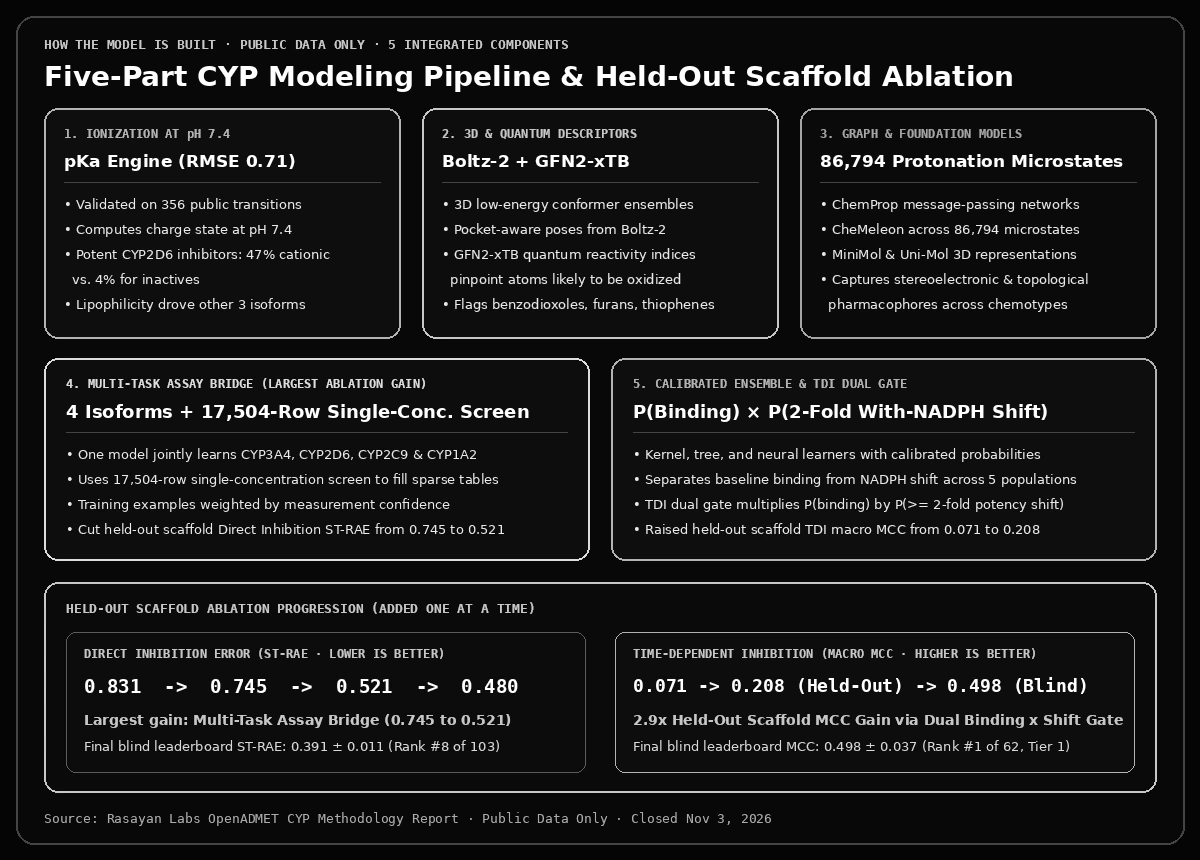
The full details are in our methodology report. We used public data only. Five parts work together:
- Ionization. A pKa engine (RMSE 0.71 on 356 public transitions) gives each molecule's charge state at pH 7.4. Potent CYP2D6 inhibitors averaged 47% cationic against 4% for inactives. For the other isoforms, lipophilicity drove potency.
- 3D and quantum descriptors. Conformers, pocket-aware poses from Boltz-2, and GFN2-xTB reactivity indices that point to atoms likely to be oxidized.
- Graph and foundation models. ChemProp, CheMeleon, MiniMol and Uni-Mol, with CheMeleon run across 86,794 protonation microstates.
- Multi-task assay bridge. One model learns all four isoforms, using a 17,504-row single-concentration screen to fill sparse tables, with training weighted by measurement confidence.
- Calibrated ensemble. Kernel, tree and neural learners combined, with a TDI dual gate that multiplies the probability of binding by the probability of a 2-fold potency shift.
Added one at a time and scored on held-out scaffolds, these parts cut Direct Inhibition error (ST-RAE) from 0.831 to 0.480, with the multi-task bridge giving the largest gain (0.745 to 0.521). TDI macro MCC rose from 0.071 to 0.208.
What's next
Blind challenges are the right test for a platform like ours. Predictions get scored against data nobody had seen. Our next step is a fix for the hidden-compound gap, then folding these CYP models into the ADMET module inside Rasayan.
Thank you to the entire OpenADMET team, and especially Pat Walters and Hugo MacDermott-Opeskin, for an open, rigorous benchmark. Thank you also to its funders: ARPA-H, Radial (part of the Astera Institute), Schrödinger, the Gates Foundation, and the OpenAI Foundation.
Review our complete OpenADMET CYP450 and PXR technical monographs, or connect directly with Rasayan Labs.