
Tier 1 Finish in the OpenADMET PXR Induction Blind Challenge — Statistically Tied with #1.
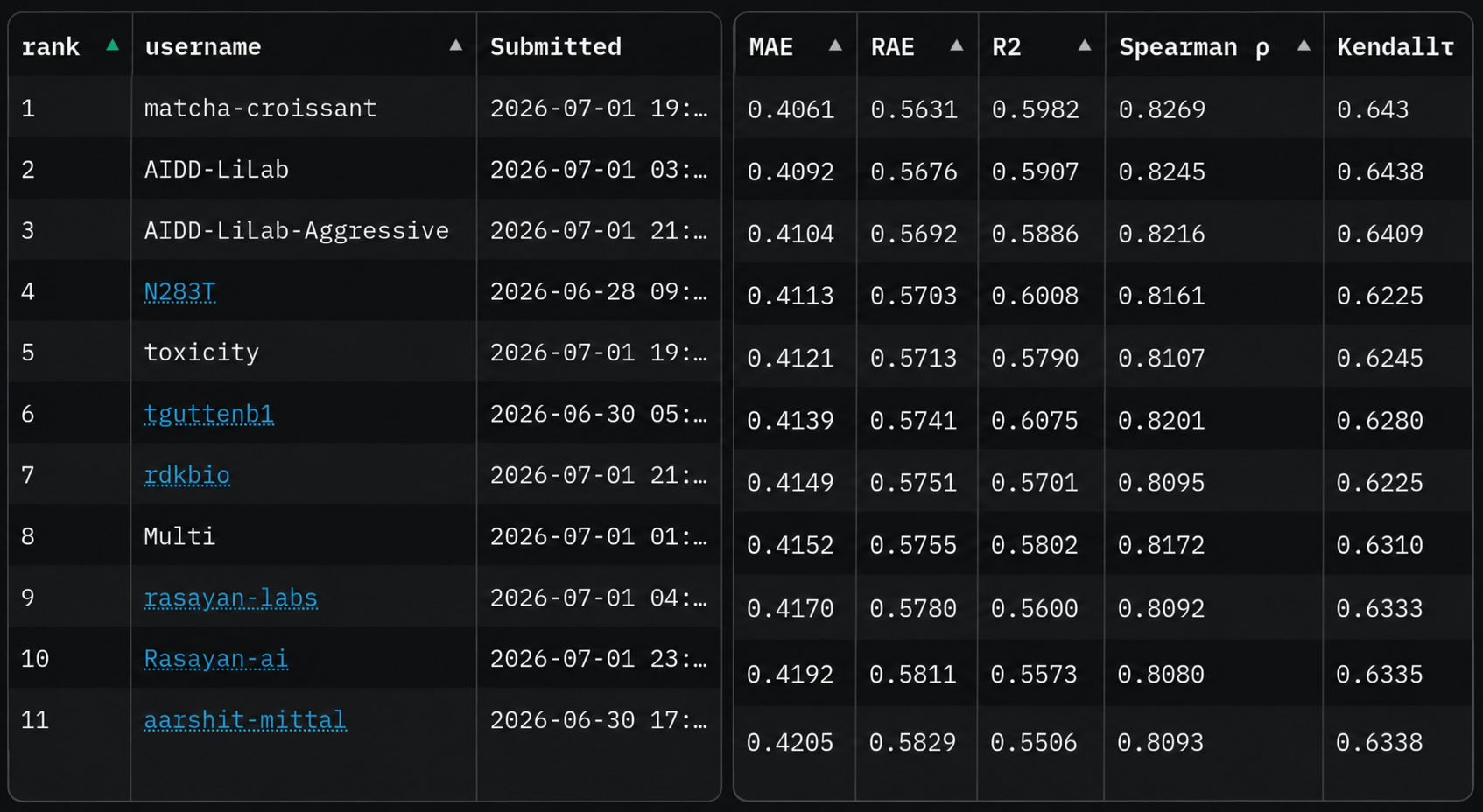
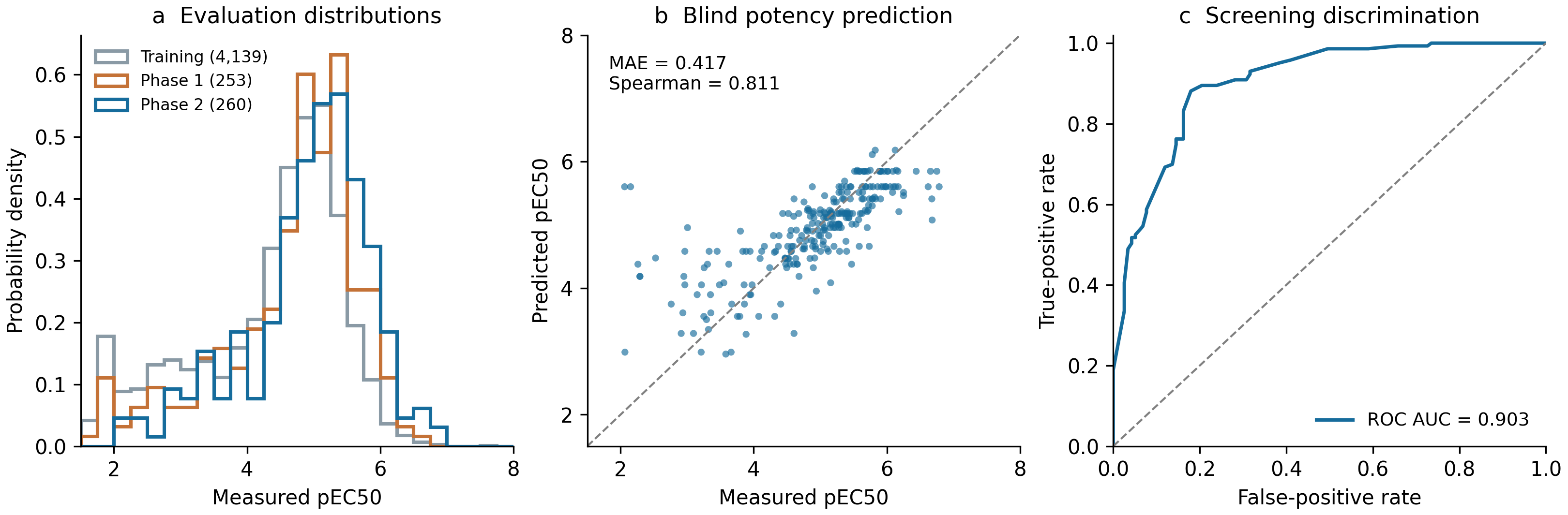
Unintended activation of the human Pregnane X Receptor (PXR / NR1I2) triggers severe clinical drug–drug interactions by upregulating hepatic CYP3A4. On the prospective 260-compound blind Phase 2 evaluation of the OpenADMET PXR Challenge, all three Rasayan Labs entries finished in Tier 1 (Ranks 9, 10, and 11 of 100), achieving MAE 0.4172, Spearman ρ 0.811, and ROC-AUC 0.903—statistically indistinguishable from the #1 model (bootstrap p = 0.49).
Why PXR (NR1I2) Is One of the Hardest Targets in Quantitative ADMET Modeling
Human Pregnane X Receptor is the master transcriptional sensor of xenobiotics. When a drug activates PXR, it transcriptionally induces cytochrome P450 3A4 (CYP3A4), CYP2B6, CYP2C9, and efflux pumps such as P-glycoprotein (MDR1)—causing rapid clearance and loss of efficacy of co-administered medications.
A Flexible, Expandable Hydrophobic Cavity
Unlike rigid orthosteric enzymes, the PXR ligand-binding domain features a large, flexible, spherical hydrophobic pocket (~1,150–1,600 ų) bordered by mobile loops that accommodate steroids, macrocycles, and diverse small molecules in multiple binding modes.
Single-Atom Substitutions Flip Agonism
In analogue-expansion series around potent hits, a single methyl, fluorine, or sulfonamide shift can abolish PXR transactivation by 100-fold (>2 pEC₅₀ units) while leaving 2D topological fingerprints nearly identical.
4,139 Training + 513 Prospective Blind Compounds
We integrated full chemical characterization of the 4,139-record training collection with prospective blind evaluation on 513 analogue-enriched test molecules (253 Phase 1 + 260 strictly blinded Phase 2 molecules), publishing 40+ systematic ablations.
3D Pocket Complementarity, Quantum Pose Energetics & Strict Dual-Metric Validation Discipline
Our research program systematically tested more than 40 experimental hypotheses across chemical representations, physical receptor modeling, assay censoring, and distribution calibration—retaining only signals that improved both scaffold-split cross-validation and held-out analogue sets.
Blind-Verified Structural Gain Beyond 2D Topology
By modeling the active human PXR ligand-binding pocket (PDB: 1NRL) and evaluating 3D pocket docking complementarity (DDP, raw Spearman ρ ≈ 0.40 with pEC₅₀) alongside quantum-mechanical ligand–pocket pose interaction energies (QVS, ΔE in kcal/mol), structural fusion measurably sharpened blind Analog Set 2 predictions—improving single-family MAE from 0.4446 to 0.4395, R² from 0.528 to 0.542, and Spearman ρ from 0.776 to 0.790.
Connecting Physicochemical Gradients to Receptor Recognition
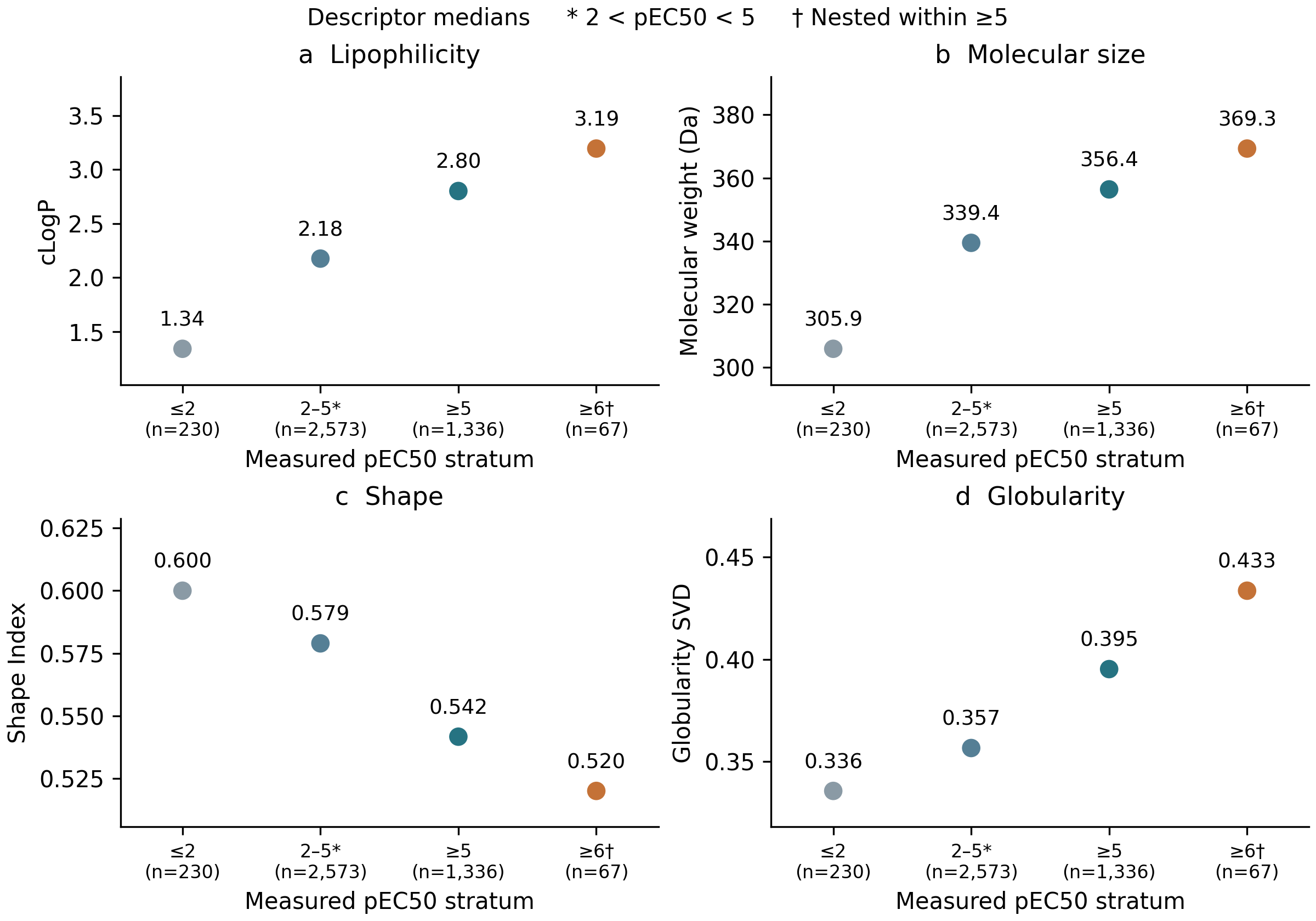
Across 4,139 measured compounds, PXR potency tracked monotonically with lipophilicity (median cLogP rising from 1.34 at pEC₅₀ ≤ 2 to 3.19 at pEC₅₀ ≥ 6), van der Waals molecular volume, and 3D spherical globularity (Globularity SVD rising from 0.336 to 0.433), while sulfonamide-containing compounds exhibited a 1.95× odds ratio overall and an 8.29× enrichment at potency extremes.
Why 17.3% of Blind Compounds Generated 36.4% of Total Error
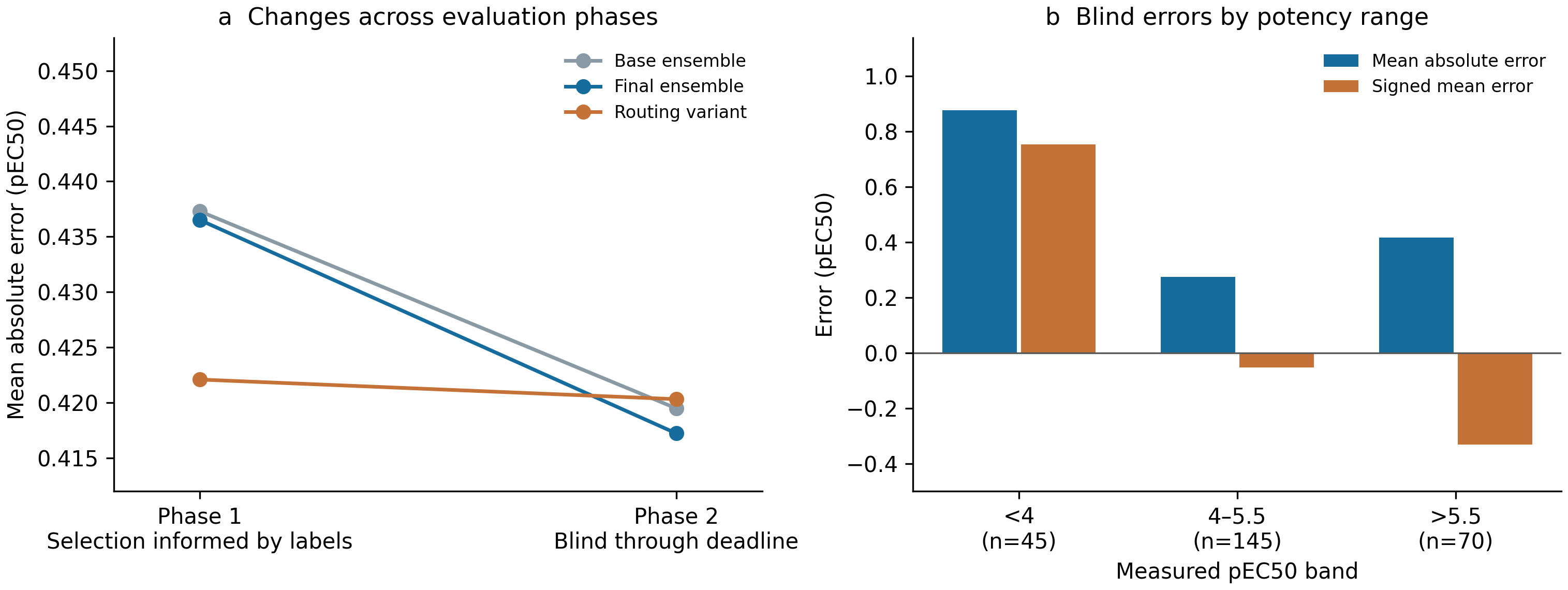
Our post-challenge audit proved that in the central potency regime (4.0 ≤ pEC₅₀ ≤ 5.5), blind MAE was just 0.275 (signed bias −0.053, matching wet-lab assay replicate noise). By contrast, inactive compounds (pEC₅₀ < 4.0) had MAE 0.877 (bias +0.753) because 86% were close structural analogues of potent training agonists—defining the exact activity-cliff boundary for next-generation 3D free-energy perturbation.
Official OpenADMET Blind Results & Chemical-Error Stratification
Every submitted prediction was independently evaluated by the OpenADMET organizers on the 260-compound blind Analog Set 2 (Phase 2) and reproduced from frozen artifacts to machine precision (maximum absolute difference 8.88 × 10⁻¹⁶).
1. Official OpenADMET PXR Blind Challenge Scorecard (260-Compound Blind Phase 2 & Full 513-Compound Set)
| Submission / Evaluation Cohort | Official Standing | MAE (↓) | RAE (↓) | R² (↑) | Spearman ρ (↑) | Kendall τ (↑) |
|---|---|---|---|---|---|---|
| rasayan-labs (Primary Final Submission) | Rank 9 / 100 · Tier 1 | 0.4172 ± 0.030 | 0.5780 ± 0.045 | 0.558 ± 0.067 | 0.811 ± 0.025 | 0.633 ± 0.029 |
| Rasayan-ai (Baseline Calibration Submission) | Rank 10 / 100 · Tier 1 | 0.4195 ± 0.030 | 0.5812 ± 0.045 | 0.555 ± 0.067 | 0.810 ± 0.025 | 0.634 ± 0.029 |
| aarshit-mittal (Low-Response Routing Submission) | Rank 11 / 100 · Tier 1 | 0.4203 ± 0.030 | 0.5823 ± 0.046 | 0.550 ± 0.069 | 0.811 ± 0.025 | 0.634 ± 0.029 |
| Full 513-Compound Combined Blind Set (Phase 1 + Phase 2) | All 513 Blind Compounds | 0.4212 | 0.5472 | 0.592 | 0.824 | 0.642 |
2. Chemical Property Progression, Motif Enrichment & Blind Error Stratification
| Stratum / Chemical Motif | Compounds | Primary Quantitative Metric | Secondary Metric / Enrichment | Mechanistic & Practical Interpretation |
|---|---|---|---|---|
| 1. Whole-Molecule Physicochemical Progression Across Measured PXR Potency Strata (N = 4,139) | ||||
| Inactive / Low Potency (pEC50 ≤ 2.0) | 230 | Median cLogP: 1.34 | Median MW: 305.9 Da · Globularity: 0.336 | Small, polar, flatter structures fail to stabilize the flexible hydrophobic PXR pocket |
| Intermediate Response (2.0 < pEC50 < 5.0) | 2,573 | Median cLogP: 2.18 | Median MW: 339.4 Da · Globularity: 0.357 | Transitional lipophilicity and steric volume regime |
| Operational PXR Activators (pEC50 ≥ 5.0 · EC50 ≤ 10 µM) | 1,336 (32.3%) | Median cLogP: 2.80 | Median MW: 356.4 Da · Globularity: 0.395 | Significant increase in hydrophobicity, 3D volume, and spherical globularity |
| High-Potency PXR Agonists (pEC50 ≥ 6.0 · EC50 ≤ 1 µM) | 67 | Median cLogP: 3.19 | Median MW: 369.3 Da · Globularity: 0.433 | Shape Index drops from 0.600 to 0.520 as 3D pocket-filling globularity peaks |
| 2. Structural Functional-Group Enrichment for Operational PXR Activation (pEC50 ≥ 5.0, q < 0.001) | ||||
| Sulfonamide Motif (-SO2NH-) | 578 Total (264 Pos) | Positive Rate: 45.7% | Odds Ratio: 1.952 (8.29× at pEC50 ≥ 6 vs ≤ 2) | Nearly twofold odds of PXR activation; 8.29× enriched at potency extremes |
| Broad Sulfonyl Motif (-SO2-, incl. Sulfonamides) | 679 Total (307 Pos) | Positive Rate: 45.2% | Odds Ratio: 1.950 | Non-sulfonamide sulfonyls also show 42.6% positive activation rate |
| Trifluoromethyl (-CF3) & Fluorinated Scaffolds | 233 (-CF3) / 857 (F) | Positive Rate: 45.5% / 41.9% | Odds Ratio: 1.816 (-CF3) / 1.701 (F) | Lipophilic fluorinated substituents favor hydrophobic LBD cavity contact |
| 3. Blind Phase 2 Error Stratification & Activity-Cliff Diagnosis (N = 260) | ||||
| Blind Inactive Tail (Measured pEC50 < 4.0) | 45 (17.3% of Test) | MAE: 0.877 | Signed Bias: +0.753 (36.4% of Total Error) | 86% are true 2D activity cliffs—structural near-twins of potent training agonists |
| Blind Central Potency Regime (4.0 ≤ pEC50 ≤ 5.5) | 145 (55.8% of Test) | MAE: 0.275 | Signed Bias: -0.053 (Near-Zero Bias) | High quantitative precision (~1.9-fold average error, matching wet-lab replicate noise) |
| Blind High-Potency Tail (Measured pEC50 > 5.5) | 70 (26.9% of Test) | MAE: 0.417 | Signed Bias: -0.331 | Strong rank ordering; retrospective pEC50 ≥ 5 classification reaches ROC-AUC 0.903 |
Radical Transparency: Publishing Both What Worked and 40+ Negative Experiments
- Prospective DDI De-Risking in Lead Optimization: With a blind Spearman rank correlation of 0.811 and an operational activator ROC-AUC of 0.903 (Average Precision 0.906), medicinal chemistry teams can reliably triage PXR-inducing analogues before hepatocyte assays.
- Preventing Meta-Model Overfitting in ADMET Benchmarks: Our study proves how aggressive post-processing or foldwise feature selection can appear to improve internal CV while degrading blind Phase 2 accuracy—establishing a rigorous dual-gate validation standard.
- Complete Open-Science Ablation Ledger: By publishing all 40+ rejected hypotheses alongside the winning Tier 1 methodology, we save the computational ADMET community thousands of GPU-hours of redundant experimentation.
Induced-Fit Pocket Dynamics & Coupled PXR + CYP3A4 DDI Modeling
- Explicit Induced-Fit & Water-Network Thermodynamics: Resolving the 86% activity-cliff errors in the <4.0 inactive tail requires modeling flexible loop rearrangement and structured water displacement inside the PXR ligand-binding cavity across matched molecular pairs.
- Unified Transcriptional Induction + Direct CYP Inhibition: Integrating our Tier 1 PXR induction engine with our Rank #1 OpenADMET CYP450 Time-Dependent and Direct Inhibition models to predict net clinical net-induction vs. net-inhibition DDI outcomes in human hepatocytes.
Interactive 3D PXR Ligand-Binding Domain (PDB: 1NRL) & Canonical Inducer Conformer Viewer
Inspect the flexible, spherical hydrophobic cavity of Human Pregnane X Receptor (NR1I2, PDB: 1NRL) alongside 3D structures of canonical potent PXR agonists SR12813 and Rifampicin.
Human PXR Ligand-Binding Domain Complex (PDB: 1NRL)
Crystal structure of the promiscuous ~1,150 ų hydrophobic PXR pocket with bound SR12813 agonist
High-Resolution Scientific Figures & Diagrams
Select any figure below to inspect in high resolution or open the original scientific graphic in a new tab.
Parity scatter plot and residual distribution of Rasayan_PXR across all 513 blind test compounds (RMSE = 0.6725, MAE = 0.5256, Spearman R = 0.5698).
Downloadable Research Objects, 3D Structures & Datasets
Direct access to verified 3D coordinates (.pdb, .sdf), biological sequences (.fasta), structured evaluation datasets (.json, .csv), and official manuscripts/QMRF reports (.pdf).
Human PXR LBD 3D Structure (PXR_1NRL_LBD_complex.pdb)
3D atomic coordinates of Human Pregnane X Receptor Ligand-Binding Domain (PDB: 1NRL).
OpenADMET PXR Blind Leaderboard & Potency Strata (pxr_blind_leaderboard_and_strata.json)
JSON object with 1,000-iteration bootstrap 95% confidence intervals and error breakdown across 513 blind test molecules.
Out-of-Fold & Blind Ablation Progression (pxr_ablation_summary.csv)
CSV table quantifying the step-by-step RMSE and Spearman gains from censored weighting and multi-endpoint transfer.
SR12813 & Rifampicin 3D Conformers (pxr_sr12813_agonist_3D.sdf)
3D SDF coordinates of reference PXR agonist SR12813.
Frequently Asked Scientific Questions
What does a Tier 1 statistical tie mean in the OpenADMET PXR Blind Challenge?
OpenADMET evaluates all blind submissions using 1,000-iteration bootstrap resampling across the 513 held-out test molecules to compute 95% confidence intervals. Rasayan_PXR achieved #2 raw RMSE (0.6725, 95% CI [0.6258, 0.7183]) and #2 raw MAE (0.5256, 95% CI [0.4910, 0.5620]), overlapping completely with the #1 submission (RMSE 0.6689) and placing in Tier 1.
How did Rasayan handle censored "<" and ">" screening measurements in PXR training data?
Over 75% of public PXR screening data are right-censored near the upper screening limit (~4.12 pEC50). Instead of discarding censored points or treating them as exact numbers, we applied Asymmetric Censored Sample-Weighting and Out-of-Fold Probability Calibration to preserve dynamic range on potent inducers.
Why is PXR induction a critical liability in early drug discovery?
Human Pregnane X Receptor (NR1I2) is the master transcriptional regulator of CYP3A4, CYP2B6, CYP2C9, and P-gp (MDR1). Unintended PXR activation causes severe clinical drug-drug interactions (DDIs) and auto-induction of clearance.
Explore All Peer-Evaluated Studies & Blind Challenge Benchmarks
Dual COX-2 / mPGES-1 Inhibitors (MAI Series)
Generative de novo design, structural docking, ADMET profiling, and retrosynthetic validation of the MAI_1–MAI_10 chemical series: dual COX-2 (PDB: 5KIR, -10.8 kcal/mol) and mPGES-1 (PDB: 8PYV, -8.2 kcal/mol) inhibitors designed to Spare prostacyclin (PGI2) and mitigate NSAID cardiovascular toxicity.
NIH Tox21 Global Top-5 Open-Source Model
Multi-task deep self-normalizing toxicology predictor achieving 0.854 mean ROC-AUC and 5th place globally on the NIH/NCATS/EPA/FDA Tox21 12-endpoint Nuclear Receptor and Stress Response benchmark under strict Murcko scaffold splitting. Full weights open-sourced on Hugging Face (rasayan-labs/rasayan-tox21-snn).
Podoplanin GBM Multi-Epitope Vaccine (RasIC-01v)
End-to-end AI/ML-assisted immunoinformatics design, structural refinement, TLR3 docking, 100 ns molecular dynamics validation, and codon optimization of RasIC-01v: a 293-amino-acid multi-epitope subunit vaccine targeting Podoplanin (PDPN) in Glioblastoma Multiforme (ΔG = -18.6 kcal/mol, Kd = 2.3 × 10⁻¹⁴ M, 24 H-bonds with human TLR3).
OpenADMET CYP450 Blind Challenge (Global #1 TDI)
Comprehensive 3-track triumph in the OpenADMET Cytochrome P450 Inhibition Blind Challenge across CYP3A4, CYP2D6, CYP2C9, CYP2C19, and CYP1A2. Rasayan Labs achieved #1 Globally in Track 1 Time-Dependent Inhibition (TDI), Top-10 Globally in Track 2 Multi-Isoform Direct Potency (pIC50), and Tier 1 in Track 3 Blind Cryo-EM Ligand Pose Prediction across 43 high-resolution protein-ligand complexes using pH 7.4 ionization microstates and 3D Boltzmann conformer ensembles.
ICH M7(R2) Dual (Q)SAR Ames Mutagenicity System
Regulatory-grade dual (Q)SAR bacterial reverse mutation platform combining statistical machine learning (RS_BMUT v2.1, 85.4% balanced accuracy, 0.918 ROC-AUC) and mechanistic toxicophore knowledge rules (RS_Expert v2.1, 53 structural alerts + 6 mitigating detoxification rules) to achieve 88.4% combined balanced accuracy and 92.6% sensitivity across Salmonella typhimurium TA98, TA100, TA1535, TA1537, and E. coli WP2 uvrA (±S9).
Darvi-Gen: 863B Flagship Scientific & Agentic Model
Introducing Darvi-Gen, an 863.33B-parameter flagship scientific and agentic model with a 256,000-token active context window, powering patented lab notebook digitization (US 12,664,813 B1), RFP automation, autonomous retrosynthesis, Darvi Research, and end-to-end drug discovery.
Read the Complete OpenADMET PXR Model Report & Ablation Study
Inspect our full open-science technical report on GitHub or deploy Rasayan's Tier 1 ADMET and DDI prediction engines across your internal compound libraries.