
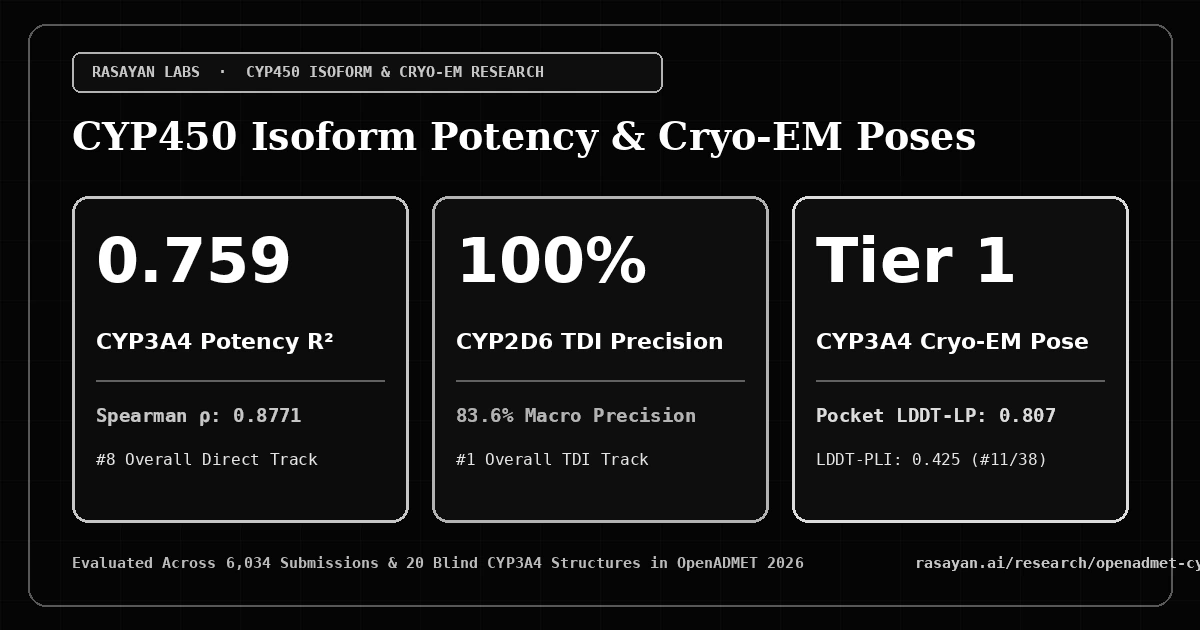
CYP3A4 R² 0.759 & Tier 1 Cryo-EM Poses
A technical deep dive into isoform-specific potency, active-site electrostatics, and 3D heme binding modes in the OpenADMET CYP450 Challenge.
Across the 2026 OpenADMET Cytochrome P450 Blind Challenge, participating research groups submitted 6,034 prediction sets evaluated on newly measured experimental data spanning four human drug-metabolizing enzymes (CYP3A4, CYP2D6, CYP2C9, and CYP1A2) and 20 newly solved ligand-bound CYP3A4 structures.
Rasayan Labs (competing as rasayan-labs) was one of only 17 teams worldwide to qualify on the official final leaderboard across all three competition tracks using exclusively public training data, finishing #1 of 62 in Time-Dependent Inhibition (MA-MCC 0.4980), #8 of 103 in Direct CYP Inhibition (MA-ST-RAE 0.3911), and #11 of 38 (Tier 1 statistical group) in CYP3A4 ligand pose prediction.
While our companion overview article summarizes our combined OpenADMET CYP and PXR standings, this technical dispatch examines the isoform-level metrics, organizational comparisons, and three-dimensional structural physics that governed performance across CYP3A4, CYP2D6, CYP2C9, and CYP1A2.
Per-Isoform Potency, TDI Precision, and Competitor Standings
In Track 1 (Direct CYP Inhibition potency across 103 ranked entries), prediction accuracy varied substantially by isoform depending on active-site volume and charge selectivity. On CYP3A4, the primary human enzyme responsible for metabolizing roughly half of clinical small-molecule drugs, our submitted model achieved an R² of 0.7588 and a Spearman rank correlation (rho) of 0.8771, alongside R² = 0.6641 (Spearman rho = 0.8104) on CYP2C9 and R² = 0.6012 on CYP2D6.
In Track 2 (Time-Dependent Inhibition classification across 62 qualified entries out of 155 participants), rasayan-labs finished #1 on the official final leaderboard with an MA-MCC of 0.4980 +/- 0.0372, macro F1 of 0.5285, macro precision of 83.6%, and 100.0% precision on CYP2D6, placing in the top statistical Tier 1 group alongside Novalix (nova, #2, MA-MCC 0.4323) and NVIDIA Healthcare BioNeMo (NV-deCYPher, #3, MA-MCC 0.4198).
In Track 3 (Blind CYP3A4 Structure Prediction across 20 newly determined experimental complexes), rasayan-labs achieved a Tier 1 statistical finish (#11 of 38) with an official protein-ligand interaction score (LDDT-PLI) of 0.4246 +/- 0.0442 and a binding-pocket backbone accuracy (LDDT-LP) of 0.8070 across 100% of evaluated targets.
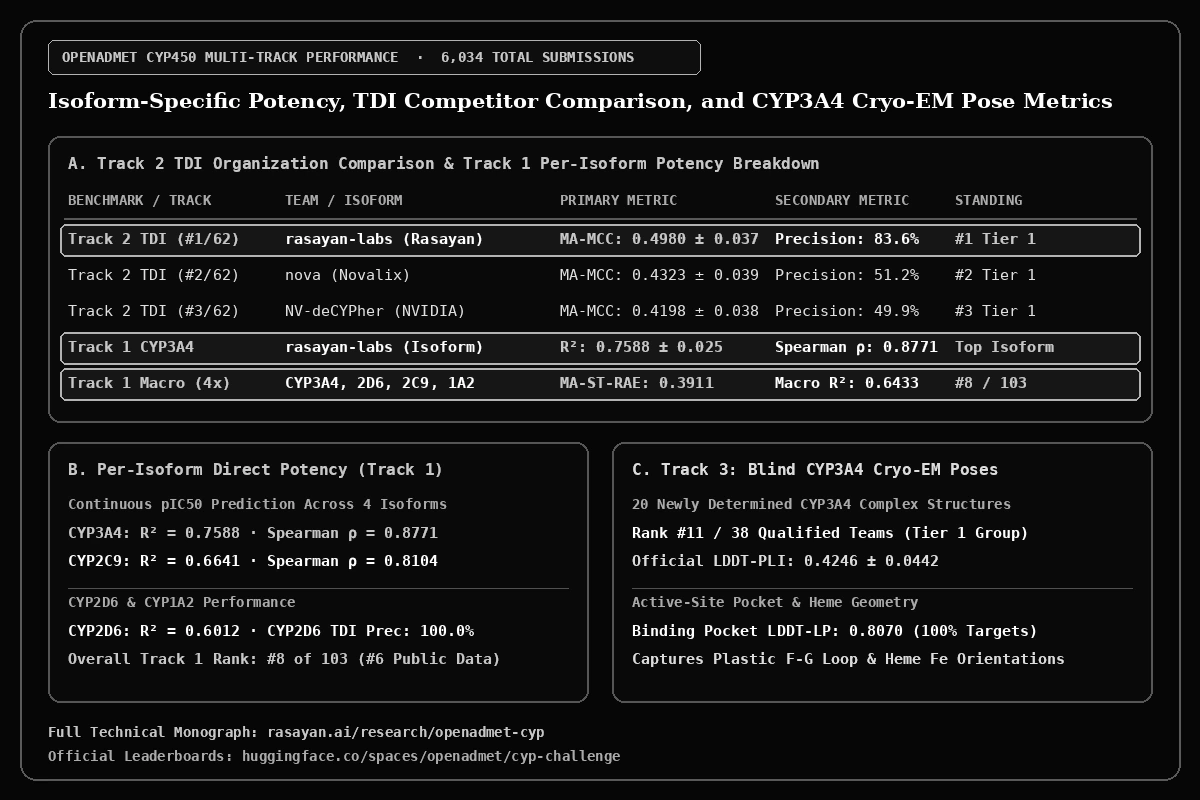
Track 1: Per-Isoform Direct Potency Breakdown (rasayan-labs)#8 of 103 · Macro R² 0.643▾
Track 2: TDI Standings & Identified Organizations#1 of 62 · MA-MCC 0.498▾
Track 3: Blind CYP3A4 Ligand-Bound Pose Evaluation (20 Complexes)#11 of 38 · Tier 1 Group▾
Why Isoform Electrostatics and CYP3A4 Plasticity Challenge Standard Models
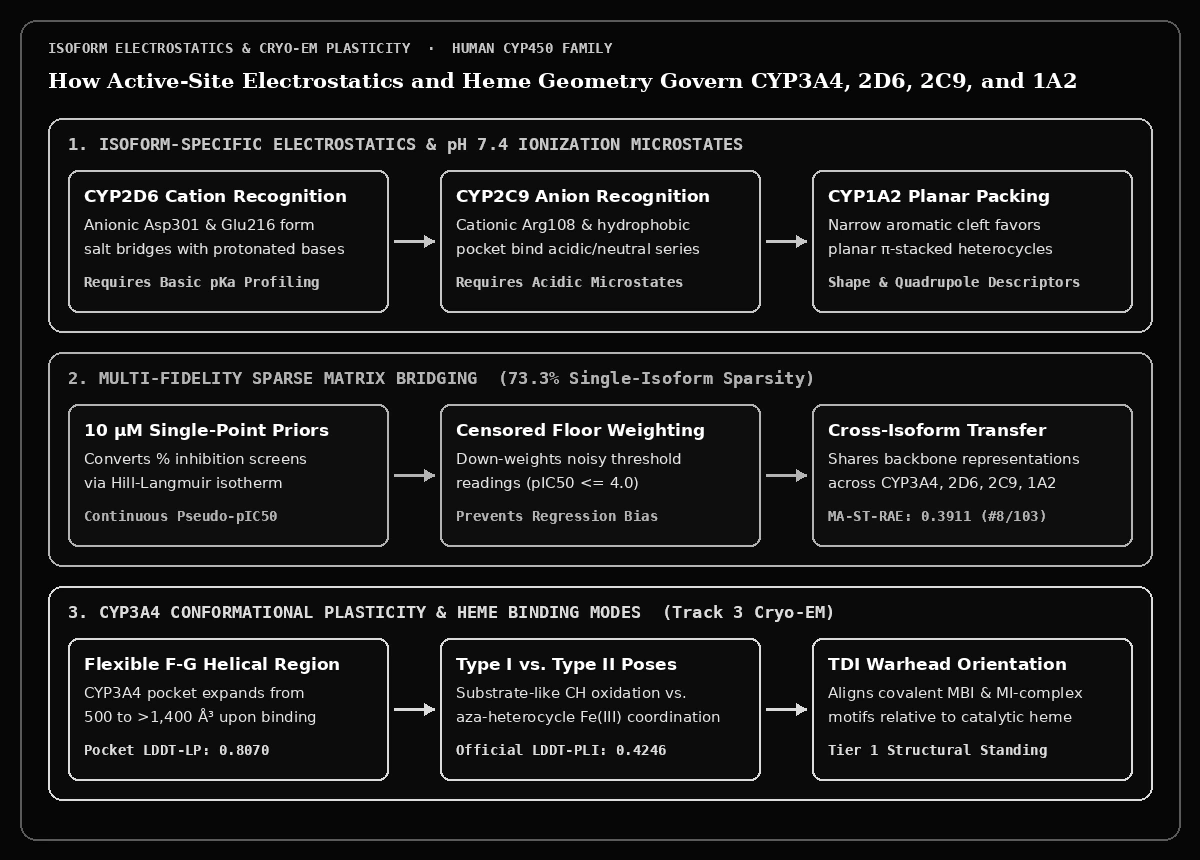
Although CYP3A4, CYP2D6, CYP2C9, and CYP1A2 share a conserved cytochrome P450 fold and a catalytic cysteinato-heme prosthetic group, their substrate and inhibitor recognition profiles diverge sharply. CYP2D6 features a compact cavity lined by negatively charged carboxylate residues (Asp301 and Glu216) that form electrostatic salt bridges with basic nitrogen cations protonated at physiological pH 7.4.
By contrast, CYP2C9 utilizes a basic Arg108 residue and hydrophobic cleft to bind weakly acidic and neutral scaffolds, CYP1A2 restricts binding to narrow planar aromatic systems capable of pi-pi stacking, and CYP3A4 possesses a highly malleable F-G helical roof whose cavity volume can expand from roughly 500 cubic angstroms to well over 1,400 cubic angstroms upon binding bulky lipophilic ligands.
How Rasayan Engineered Cross-Isoform and Structural Generalization
To capture isoform selectivity without overfitting to sparse single-target subsets, our submitted pipeline combined three domain-specific layers documented in our OpenADMET CYP450 monograph. First, we computed explicit physiological pH 7.4 protonation microstates, site-specific pKa values, and log D7.4 descriptors so the model could distinguish cationic CYP2D6 ligands from anionic CYP2C9 scaffolds.
Second, because 73.3% of compound-isoform pairs in the public dose-response matrix lacked full multi-point IC50 curves, we converted 10 µM single-concentration percent-inhibition measurements into continuous Hill-Langmuir pseudo-pIC50 priors and down-weighted censored floor readings (pIC50 at or below 4.0).
Third, for Track 3 structure prediction and Track 2 TDI classification, we modeled ligand orientation relative to the catalytic heme iron, distinguishing non-covalent Type II aza-heterocycle coordination from covalent mechanism-based inactivation warheads and quasi-irreversible metabolite-intermediate complex motifs.
Practical Impact for DMPK and Lead Optimization Teams
In early medicinal chemistry campaigns, a modification that removes a CYP3A4 liability frequently shifts inhibition toward CYP2D6 or CYP2C9. Evaluating all four major isoforms simultaneously alongside 3D heme binding poses allows discovery teams to diagnose whether metabolic inhibition stems from a replaceable heme-coordinating heterocycle, global lipophilicity, or a reactive bioactivation motif before committing to wet-lab microsomal panels.
Methodological Note on the OpenADMET TDI Evaluation
Under OpenADMET's published competition rules, the official final CYP Time-Dependent Inhibition (TDI) leaderboard evaluated predictions across the combined test set of live-scored and previously hidden holdout compounds, where rasayan-labs ranked #1 overall (MA-MCC 0.498). In a post-competition analysis restricted to the previously hidden half of the TDI test set, rasayan-labs recorded an MA-MCC of 0.235 (rank #52). OpenADMET confirmed that the official final leaderboard standing is valid under the competition rules while noting the evaluation design trade-offs of combining live and hidden splits.
OpenADMET CYP Challenge Evaluation ReportReview our complete OpenADMET CYP450 and PXR technical monographs, or connect directly with Rasayan Labs.