
Rasayan Labs Ranks #1 in CYP Time-Dependent Inhibition
Independently evaluated results from two international drug metabolism challenges.
Rasayan Labs achieved the top official ranking in CYP TDI and further top-ten results in direct inhibition and PXR activity prediction. Competing in OpenADMET's Cytochrome P450 Time-Dependent Inhibition challenge, our team secured the #1 position on the official final leaderboard.
Across the companion tracks and prior nuclear receptor benchmark, Rasayan Labs also ranked #8 in Direct CYP Inhibition and achieved a Tier 1, ninth-place finish in the Pregnane X Receptor (PXR) activity prediction challenge.
Organized by the OpenADMET consortium, these international benchmarks evaluated how accurately computational methods predict cytochrome P450 enzyme inhibition (both time-dependent inhibition and direct inhibition potency), PXR agonism, and protein-ligand pose prediction across newly generated experimental datasets. Together, these results mark an important milestone for our research in predictive drug metabolism, molecular modeling, and AI-assisted drug discovery.
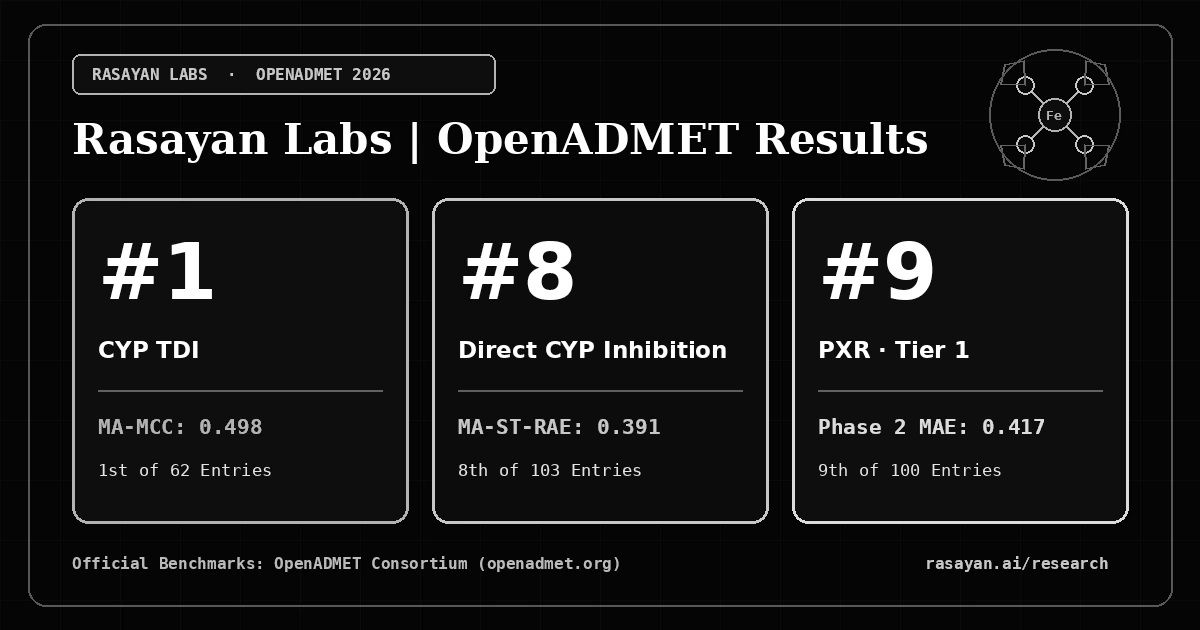
Official Results Across Two OpenADMET Benchmarks
In the CYP Time-Dependent Inhibition (TDI) classification track, Rasayan Labs (competing as rasayan-labs) ranked #1 out of 62 qualified final entries with an official macro-averaged Matthews Correlation Coefficient (MA-MCC) of 0.498, alongside a macro F1 score of 0.529 and macro precision of 83.6%. MA-MCC measures balanced binary classification quality across active and inactive compounds even when experimental classes are imbalanced.
In the Direct CYP Inhibition potency track across CYP3A4, CYP2D6, CYP2C9, and CYP1A2, Rasayan Labs placed #8 out of 103 ranked entries with an official macro-averaged scaled-truncated relative absolute error (MA-ST-RAE) of 0.391 and macro R² of 0.643, reflecting continuous potency accuracy relative to the experimental dynamic range.
In the earlier OpenADMET PXR challenge, Rasayan Labs ranked #9 out of 100 entries within the Tier 1 statistical group on the official Phase 2 evaluation set (N = 260), recording an official mean absolute error (MAE) of 0.417 (distinct from post-challenge evaluations calculated across the larger 513-compound combined Phase 1 and Phase 2 dataset).
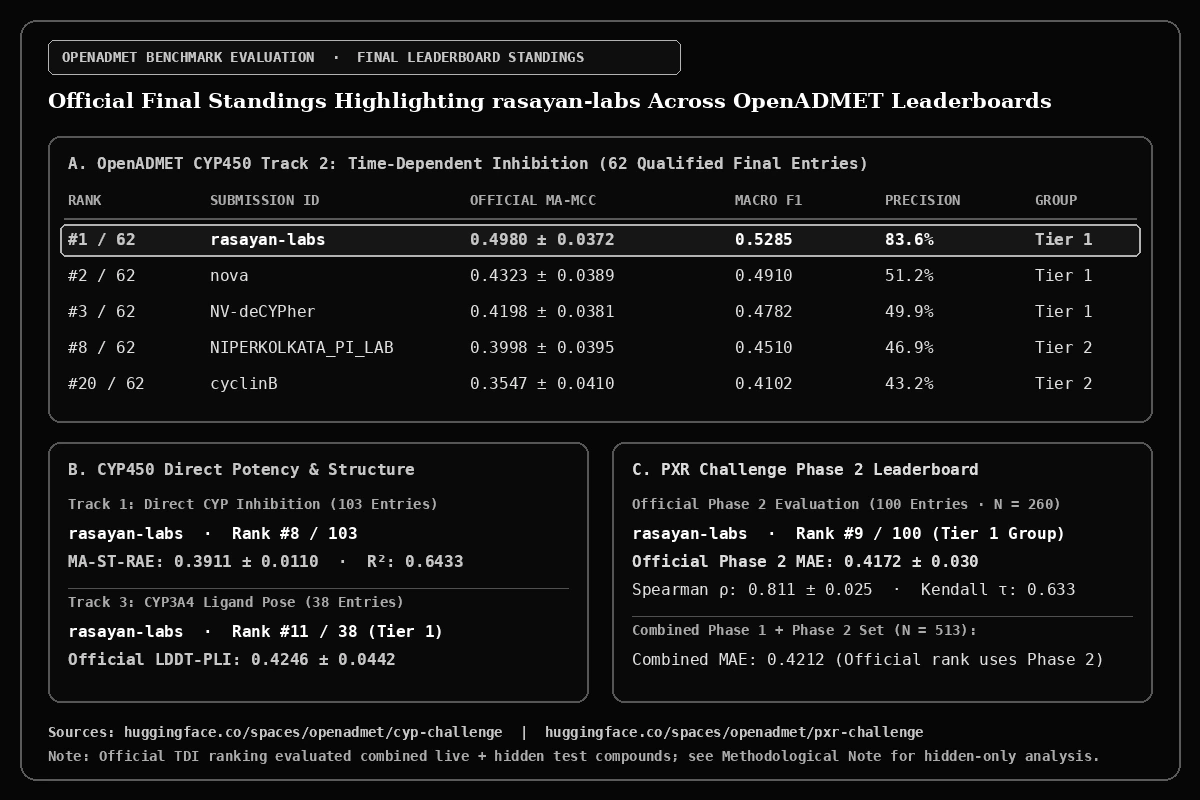
Track 2: CYP Time-Dependent Inhibition (Official Final Leaderboard)#1 of 62 · Tier 1▾
Track 1: Direct CYP Inhibition & Track 3: CYP3A4 Pose Prediction#8 Direct · #11 Pose (Tier 1)▾
PXR Activity Prediction (Official Phase 2 Final Leaderboard)#9 of 100 · Tier 1▾
Why CYP Inhibition and PXR Induction Matter in Drug Discovery
In medicinal chemistry and drug metabolism and pharmacokinetics (DMPK), human cytochrome P450 enzymes and nuclear receptors regulate how drug candidates are metabolized and whether they precipitate clinical drug-drug interactions (DDIs). Identifying enzyme inhibition and induction liabilities early helps discovery teams prioritize chemical series with cleaner pharmacokinetic profiles before committing extensive resources to synthesis and preclinical development.
Time-dependent CYP inhibition (TDI), measured experimentally as an increase in inhibitory potency following NADPH-dependent catalytic pre-incubation, is a particularly critical DMPK liability. The measured TDI phenotype encompasses both irreversible mechanism-based inactivation, where reactive oxidation intermediates such as epoxides or quinone-imines covalently modify the heme prosthetic group or apoprotein, and quasi-irreversible metabolite-intermediate (MI) complexation, where metabolic species such as nitrosoalkanes or carbenes coordinate tightly to the ferrous Fe(II) heme iron, alongside the generation of potent oxidized metabolites.
Direct CYP inhibition potency across major human isoforms (CYP3A4, CYP2D6, CYP2C9, and CYP1A2) similarly alters co-medication exposure when compounds inhibit catalytic turnover in the enzyme active site. Conversely, small-molecule activation of the pregnane X receptor (PXR), which pairs with its obligate heterodimerization partner RXRα to bind promoter response elements, transcriptionally upregulates CYP3A4 expression and can accelerate metabolic clearance of co-administered drugs. While in silico predictions do not replace experimental ADME assays or clinical safety evaluation, accurate computational models help teams flag high-risk scaffolds prior to synthesis.
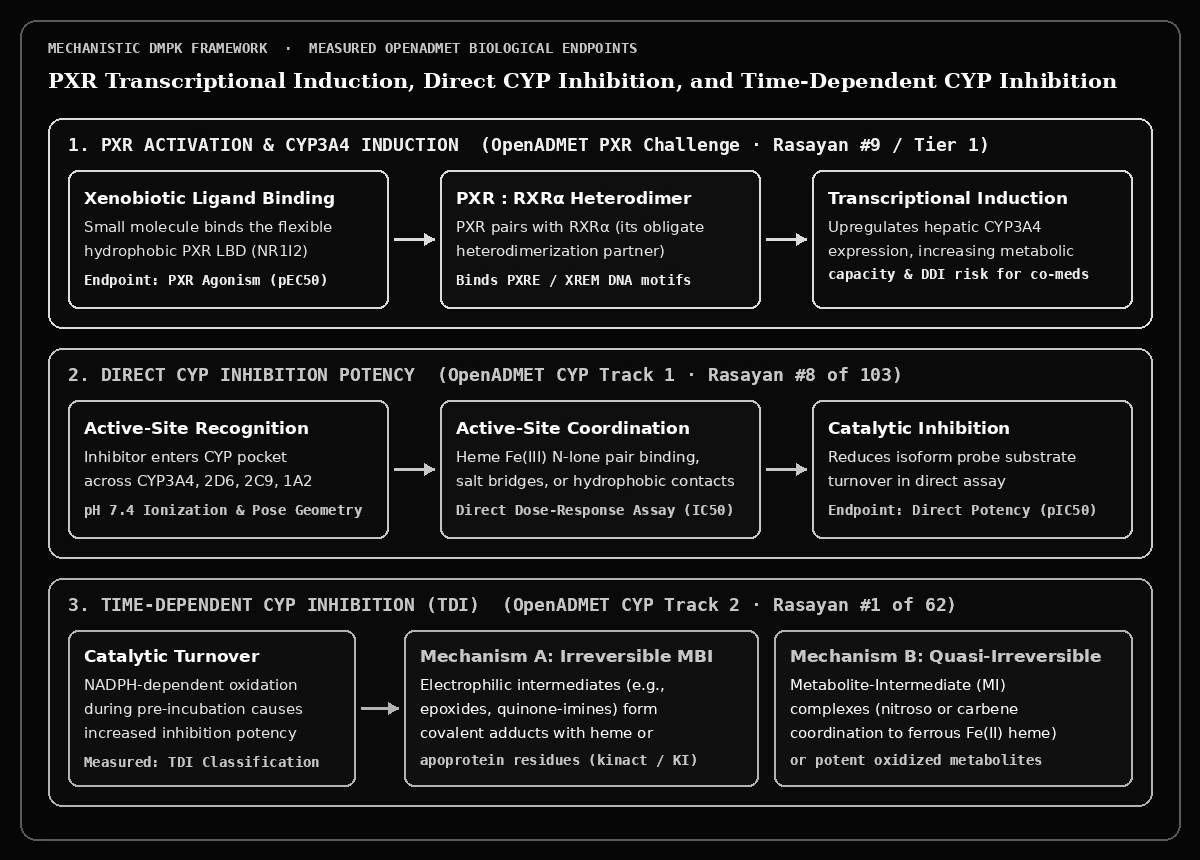
How Rasayan Approached the Science
Predicting drug metabolism liabilities across diverse chemical series requires combining physical organic chemistry, assay-aware data curation, and machine learning. Rather than relying on generic two-dimensional molecular representations alone, our submitted OpenADMET CYP450 and PXR models integrated three domain-specific components documented in our public technical reports (rasayan.ai/research/openadmet-cyp and rasayan.ai/research/openadmet-pxr).
First, our submitted CYP450 and PXR feature pipelines incorporated physiological pH 7.4 ionization and microstate profiling by computing site-specific acid-base dissociation constants (pKa), Henderson-Hasselbalch protonation state fractions, and lipophilicity distribution coefficients (log D7.4). Because human CYP isoforms differ in active-site electrostatics (such as anionic Asp301 and Glu216 in CYP2D6 or cationic Arg108 in CYP2C9), explicit ionization features provided physical context that neutral topological graphs omit.
Second, to address the 73.3% single-isoform sparsity in the OpenADMET CYP450 dose-response training matrix, our Track 1 potency pipeline bridged multi-fidelity screening data by converting 10 µM single-concentration percent-inhibition measurements into continuous Hill-Langmuir pseudo-pIC50 priors and down-weighting censored floor readings (pIC50 at or below 4.0) relative to resolved dose-response curves.
Third, our Track 2 TDI classifier paired cross-isoform direct potency representations with curated substructure descriptors covering covalent mechanism-based inactivation warheads and quasi-irreversible metabolite-intermediate complex-forming motifs, while our submitted PXR ensemble combined 3D Boltzmann-weighted conformer descriptors with 2D activity-cliff corrections.
Broader Performance Across CYP3A4 Structure Prediction
Alongside catalytic inhibition and PXR induction, the OpenADMET Cytochrome P450 challenge featured a third track evaluating blind ligand-bound structure prediction across 20 newly determined CYP3A4 structures.
In this structural biology track, Rasayan Labs ranked #11 out of 38 qualified entries and placed within the Tier 1 statistical group, recording an official protein-ligand interaction local distance difference test score (LDDT-PLI) of 0.425.
Predicting three-dimensional ligand poses inside the conformationally plastic CYP3A4 active site naturally complements potency and time-dependent inhibition modeling. Evaluating how a chemical scaffold orientates relative to the catalytic heme center provides valuable structural context alongside quantitative activity predictions, demonstrating the breadth of our computational chemistry research across both ligand-based and structure-aware tasks.
What This Means for Pharmaceutical Research Teams
For scientific directors, heads of drug discovery, and DMPK scientists, community benchmarks provide a transparent reference point for assessing computational models on novel chemical series. Predictive models evaluated in blind benchmarks across time-dependent CYP inhibition, direct CYP inhibition potency, and PXR activation can support several practical decisions in early discovery.
During virtual screening and lead optimization, integrating these predictions can assist in identifying potential metabolic liabilities earlier in design cycles and supporting data-informed compound prioritization before synthetic chemistry resources are committed. Within multiparameter medicinal chemistry optimization, quantitative risk scores help teams evaluate trade-offs between primary target affinity, lipophilicity, and metabolic stability.
Across ADMET and DMPK workflows, calibrated in silico models can also help focus wet-lab microsomal and hepatocyte assay capacity on higher-priority candidates, serving as practical decision-support tools integrated into existing discovery pipelines.
Advancing Predictive Drug Discovery
Rigorous community benchmarks are vital for measuring genuine progress in computational chemistry and machine learning for drug discovery. We thank the OpenADMET consortium and its experimental partners for generating high-quality public datasets and establishing transparent evaluation standards.
At Rasayan Labs, we remain committed to advancing predictive drug metabolism research, mechanistic molecular modeling, and scientific benchmarking. We invite pharmaceutical researchers, DMPK scientists, and R&D leaders to explore our detailed OpenADMET research monographs or initiate a scientific discussion with our team.
Methodological Note on the OpenADMET TDI Evaluation
Under OpenADMET's published competition rules, the official final CYP Time-Dependent Inhibition (TDI) leaderboard evaluated predictions across the combined test set of live-scored and previously hidden holdout compounds, where rasayan-labs ranked #1 overall (MA-MCC 0.498). In a post-competition analysis restricted to the previously hidden half of the TDI test set, rasayan-labs recorded an MA-MCC of 0.235 (rank #52). OpenADMET confirmed that the official final leaderboard standing is valid under the competition rules while noting the evaluation design trade-offs of combining live and hidden splits; accordingly, our #1 TDI result is presented as the official benchmark standing rather than standalone proof of uniform generalization across all unseen scaffolds.
OpenADMET CYP Challenge Evaluation ReportReview our complete OpenADMET CYP450 and PXR technical monographs, or connect directly with Rasayan Labs.
References
- [1]Take Me Heme, Binding Modes: Wrapping Up the CYP Inhibition Challenge (OpenADMET Consortium) ↗
- [2]OpenADMET CYP450 Challenge Official Final Leaderboard (OpenADMET Consortium) ↗
- [3]It's the End of the PXR Challenge as We Know It (And I Feel Fine) (OpenADMET Consortium) ↗
- [4]OpenADMET PXR Challenge Official Final Leaderboard (OpenADMET Consortium) ↗
- [5]Rasayan Labs OpenADMET CYP450 Technical Monograph (Rasayan Labs Inc.) ↗
- [6]Rasayan Labs OpenADMET PXR Technical Monograph (Rasayan Labs Inc.) ↗