
ICH M7(R2)-Compliant Dual (Q)SAR System (RS_BMUT & RS_Expert) for Ames Mutagenicity.
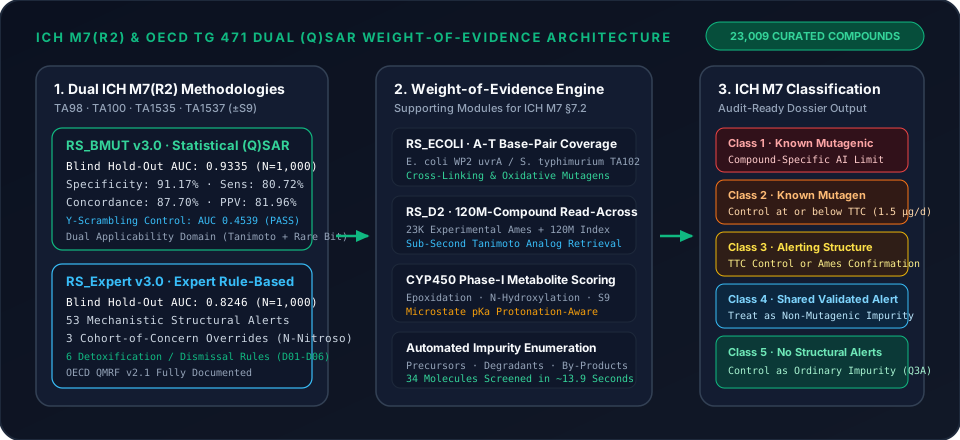
Under ICH M7(R2), every pharmaceutical impurity must be evaluated using two complementary (Q)SAR methodologies—one statistical and one expert rule-based. Trained and calibrated on 23,009 curated OECD TG 471 compounds, RS_BMUT achieves a locked 1,000-compound external blind AUC-ROC of 0.9335 (91.17% specificity, 87.70% concordance) alongside RS_Expert (53 mechanistic alerts + 6 detoxification rules), automated synthesis-impurity enumeration, CYP450 metabolite scoring, and 120M-compound read-across.
Closing the Regulatory & Accessibility Gap in ICH M7(R2) Mutagenic Impurity Control
DNA-reactive impurities formed during API synthesis or shelf-life degradation pose carcinogenic hazards even at trace parts-per-million levels. While ICH M7(R2) accepts computational (Q)SAR in lieu of wet-lab bacterial testing for Class 4 and Class 5 impurities, existing commercial systems leave two major scientific and operational gaps.
API Parents Pass While Process Impurities Fail
Legacy tools evaluate only the single SMILES string a user manually pastes. Yet real-world recalls (such as sartan N-nitrosamine contamination) arise from unenumerated route precursors, alkylating reagents, and oxidative degradants.
Academic Labs & Emerging CROs Priced Out
Proprietary dual-system ICH M7 software licenses cost tens of thousands of dollars per seat per year—forcing academic drug discovery groups and emerging CDMOs to delay mutagenic impurity triage until late-stage regulatory filing.
Free on OCSR.ai + Full Route-Aware Enterprise Dossiers
On April 29, 2026, we released RS_BMUT free on OCSR.ai for any molecule, followed by full OECD QMRF v2.1 documentation and automated 34-molecule impurity + metabolite ICH M7 reporting in 13.9 seconds.
23,009 Curated Compounds, Dual Applicability Domain & Mechanistic Detoxification Rules
Built in strict adherence to the five OECD principles for (Q)SAR validation, our system pairs a probability-calibrated statistical model (RS_BMUT) with a deterministic mechanistic rule base (RS_Expert) and four orthogonal Weight-of-Evidence (WoE) engines.
Dual-Criterion Applicability Domain & Y-Scrambling Proof
Trained on 22,009 desalted, canonicalized OECD TG 471 compounds (Hansen, Bursi/CRC, U.S. NTP, CCRIS, and peer-reviewed records) and evaluated on a locked 1,000-compound external blind hold-out with zero InChIKey overlap. Every prediction is guarded by a dual-criterion Applicability Domain combining nearest-neighbor Tanimoto distance thresholds (0.64 / 0.81) and rare-substructure novelty (0.30 / 0.50), plus per-atom fragment-PPV attribution. Nine independent Y-scrambling controls collapsed blind AUC from 0.9335 to 0.4539 (MCC = 0.0000), proving genuine SAR learning.
53 Structural Alerts, 3 Cohort-of-Concern Overrides & 6 Dismissal Rules
Encodes 50 mechanistic mutagenicity alerts grounded in Ashby–Tennant, Benigni–Bossa, and Kazius toxicophores, 3 non-dismissible ICH M7 Cohort-of-Concern rules (N-nitroso, aflatoxin-like, alkyl-azoxy), and 6 mitigating detoxification rules (D01–D06) (such as sulfonic/carboxylic acid water-solubilization and ortho-steric hindrance of aromatic amines), each calibrated with empirical Positive Predictive Value (PPV) and Wilson 95% confidence intervals across all 23,009 reference compounds.
A–T Base-Pair Strain Coverage & 120M-Compound Analog Search
Standard *Salmonella* strains (TA98, TA100, TA1535, TA1537) detect G–C base-pair substitutions and frameshifts, whereas OECD TG 471 requires fifth-strain coverage at A–T base pairs for oxidizing and cross-linking mutagens—provided by RS_ECOLI (*E. coli* WP2 uvrA / TA102). Simultaneously, RS_D2 retrieves nearest experimental Ames neighbors and searches ~120M indexed compounds to support ICH M7 Class 4 shared-alert read-across arguments.
Screening API + 33 Process Impurities + CYP450 Metabolites in 13.9s
Given a single parent API (e.g., Losartan, Class 5 non-mutagenic), the system automatically enumerates process precursors, synthetic intermediates, and oxidative/hydrolytic degradants (33 impurities for Losartan), predicts Phase-I CYP450 metabolites and physiological pH 7.4 microstate pKa forms, and flags trace N-nitroso Cohort-of-Concern hazards automatically.
Locked 1,000-Compound Blind Hold-Out, 40-Fold LMO CV & Y-Scrambling Controls
All metrics below are directly audited from the published OECD QMRF v2.1 regulatory dossiers (QMRF_RS_BMUT.pdf and QMRF_RS_Expert.pdf).
1. System Origin, Regulatory Scope & Reference Dataset Specifications
| System Attribute / Regulatory Parameter | Verified OECD QMRF v2.1 Specification |
|---|---|
| Origin & Release Timeline | Build: April 21, 2026 · Free OCSR.ai Release: April 29, 2026 · Engine v3.0.0: May 1, 2026 · OECD QMRF v2.1: May 14, 2026 |
| Authors & Research Team | Aarshit Mittal, Parmi Shah, Prof. Prashant S. Kharkar (Rasayan Labs) |
| Regulatory Guideline Alignment | ICH M7(R2) (§6–§7.2), OECD Test Guideline 471, and OECD (Q)SAR Validation Principles |
| Curated Reference Chemical Corpus | 23,009 Unique Desalted Organic Compounds (7,650 Positive [33.2%] · 15,359 Negative [66.8%]) |
| Training vs. Locked External Blind Split | 22,009 Training Compounds + 1,000 Locked External Blind Hold-Out (Zero InChIKey Overlap · 412 Scaffolds) |
| Biological Endpoint Coverage | S. typhimurium TA98, TA100, TA1535, TA1537 (±S9) + RS_ECOLI (E. coli WP2 uvrA / TA102 A–T Base Pairs) |
| Supporting Weight-of-Evidence Modules | RS_D2 (120M-Structure Read-Across) + CYP450 Phase-I Metabolites + Automated Impurity Enumeration |
2. External Blind Hold-Out (N = 1,000), 40-Fold Cross-Validation & Y-Scrambling Scorecard
| Validation Protocol & Partition | AUC-ROC | Concordance | Sensitivity | Specificity | Predictive Values / Control Status |
|---|---|---|---|---|---|
| 1. RS_BMUT v3.0.0 · Statistical (Q)SAR Methodology (ICH M7 Complementary Methodology 1) | |||||
| Locked External Blind Hold-Out (N = 1,000 · Standard 0.50 Cutoff) | 0.9335 | 87.70% | 80.72% | 91.17% | PPV: 81.96% · NPV: 90.49% |
| Locked External Blind Hold-Out (N = 1,000 · Calibrated 0.40 Regulatory Cutoff) | 0.9329 | 87.50% | 81.32% | 90.57% | PPV: 81.08% · NPV: 90.70% |
| 40-Fold Leave-Many-Out Cross-Validation (N = 22,009 Training Set) | 0.9154 | 88.38% | 85.65% | 89.74% | Coverage: 100.0% |
| Y-Scrambling Permutation Control (9 Independent Shuffled-Label Fits) | 0.4539 (−0.479 Drop) | 66.80% (Null) | 0.00% | 100.00% | MCC: 0.0000 (PASS · Zero Memorization) |
| 2. RS_Expert v3.0.0 · Mechanistic Expert Rule-Based System (ICH M7 Complementary Methodology 2) | |||||
| Locked External Blind Hold-Out (N = 1,000 · 53 Alerts + 6 Deactivation Rules) | 0.8246 | 78.80% | 77.41% | 79.49% | MCC: 0.5484 · 15 Cohort-of-Concern Flags |
| Full Reference Knowledge-Base Calibration (N = 23,009 · Wilson 95% CI) | 0.7850 | 74.51% | 71.82% | 75.85% | NPV: 84.39% · 100% Deterministic Audit Trail |
3. RS_Expert Mechanistic Structural Alert & Detoxification Rule Taxonomy
| Toxicophore Family | Representative Structural Motifs | DNA Reactivity & Metabolic Mechanism | Regulatory Override / Mitigating Rule |
|---|---|---|---|
| ICH M7 Cohort-of-Concern Overrides (3 Rules) | N-Nitrosamines (R₂N–N=O), Aflatoxin-like Furocoumarins, Alkyl-Azoxy Compounds | Extreme carcinogenic potency below the standard 1.5 µg/day TTC; forces Class 1 / CPCA evaluation | Non-Dismissible Regulatory Override |
| Aromatic Nitrogen & Aminoaryl Mutagens (12 Alerts) | Aromatic Nitro, Primary Aromatic Amines, Polycyclic Planar Nitrenium Precursors | CYP1A2 N-hydroxylation and NAT/SULT esterification yielding DNA-adducting arylnitrenium ions | Deactivated by ortho-disubstitution steric hindrance or ring-bound -SO₃H / -COOH (D01–D03) |
| Direct-Acting Electrophilic Alkylating Agents (16 Alerts) | Epoxides, Aziridines, Nitrogen/Sulfur Mustards, Alkyl Sulfonates/Mesylates, Acyl Halides | Direct S_N1 / S_N2 covalent alkylation of nucleophilic N7-guanine and N3-adenine DNA bases | Modulated by extreme molecular weight (>1,000 Da) or high hydrophilicity LogP < -3.0 (D05–D06) |
| Michael Acceptors, Aldehydes & Intercalators (22 Alerts) | α,β-Unsaturated Carbonyls, Quinones, Hydrazines, Bay-Region PAHs, Acridine Intercalators | 1,4-Conjugate addition to exocyclic DNA bases, frameshift intercalation in TA98/TA1537, or ROS generation | Evaluated alongside RS_ECOLI (A–T base pairs) and CYP450 Phase-I metabolic bioactivation |
Making ICH M7(R2) Impurity Safety Accessible to Every Laboratory Worldwide
- Zero-Cost Public Access on OCSR.ai: Academic medicinal chemists, graduate students, and small CROs can sketch a molecule or upload a patent page on OCSR.ai and receive instant RS_BMUT mutagenicity predictions without commercial software paywalls.
- Complete OECD QMRF v2.1 Transparency: Both RS_BMUT and RS_Expert are accompanied by full 10-chapter OECD QMRF v2.1 documentation suitable for inclusion in IND, NDA, ANDA, and DMF regulatory submissions.
- Proactive Nitrosamine & Process Impurity Vigilance: By coupling automated synthetic-impurity enumeration with Cohort-of-Concern detection, CMC teams catch mutagenic route intermediates during process development rather than post-approval.
CPCA Nitrosamine Potency Categorization & Strain-Specific Attribution
- Automated CPCA Category 1–5 Acceptable Intake (AI) Calculation: Expanding our N-nitrosamine Cohort-of-Concern module to automatically compute α-hydrogen counts, activating/deactivating features, and FDA/EMA Carcinogenic Potency Categorization Approach (CPCA) Acceptable Intake limits (18 ng/day to 1,500 ng/day).
- Strain-Deconvoluted (±S9) Mechanistic Attribution: Providing separate probability heads for frameshift strains (TA98, TA1537) vs. base-pair substitution strains (TA100, TA1535, WP2 uvrA) with and without rat/hamster S9 metabolic activation.
- Direct Integration with Darvi Retrosynthesis & RFP Engine: Automatically scoring every proposed retrosynthetic disconnection for ICH M7 Class 1–5 purge factors before a synthetic route is selected.
Interactive 3D Regulatory Impurity & Reactive Metabolite Inspector: Losartan API vs. N-Nitrosamine & Epoxide Metabolites
Compare the 3D steric & electronic environments of non-mutagenic Losartan Parent API (ICH M7 Class 5) against its S9-activated N-Nitroso-Losartan impurity (Class 2/3 Cohort of Concern), Losartan 2,3-Arene Oxide reactive metabolite, and Aflatoxin B1 8,9-exo-epoxide.
Losartan Parent API — ICH M7 Class 5 Non-Mutagenic (CAS 114798-26-4)
Sterically hindered ortho-tetrazole biaryl scaffold verified negative in RS_BMUT (0.08) and RS_Expert (Detoxified)
High-Resolution Scientific Figures & Diagrams
Select any figure below to inspect in high resolution or open the original scientific graphic in a new tab.
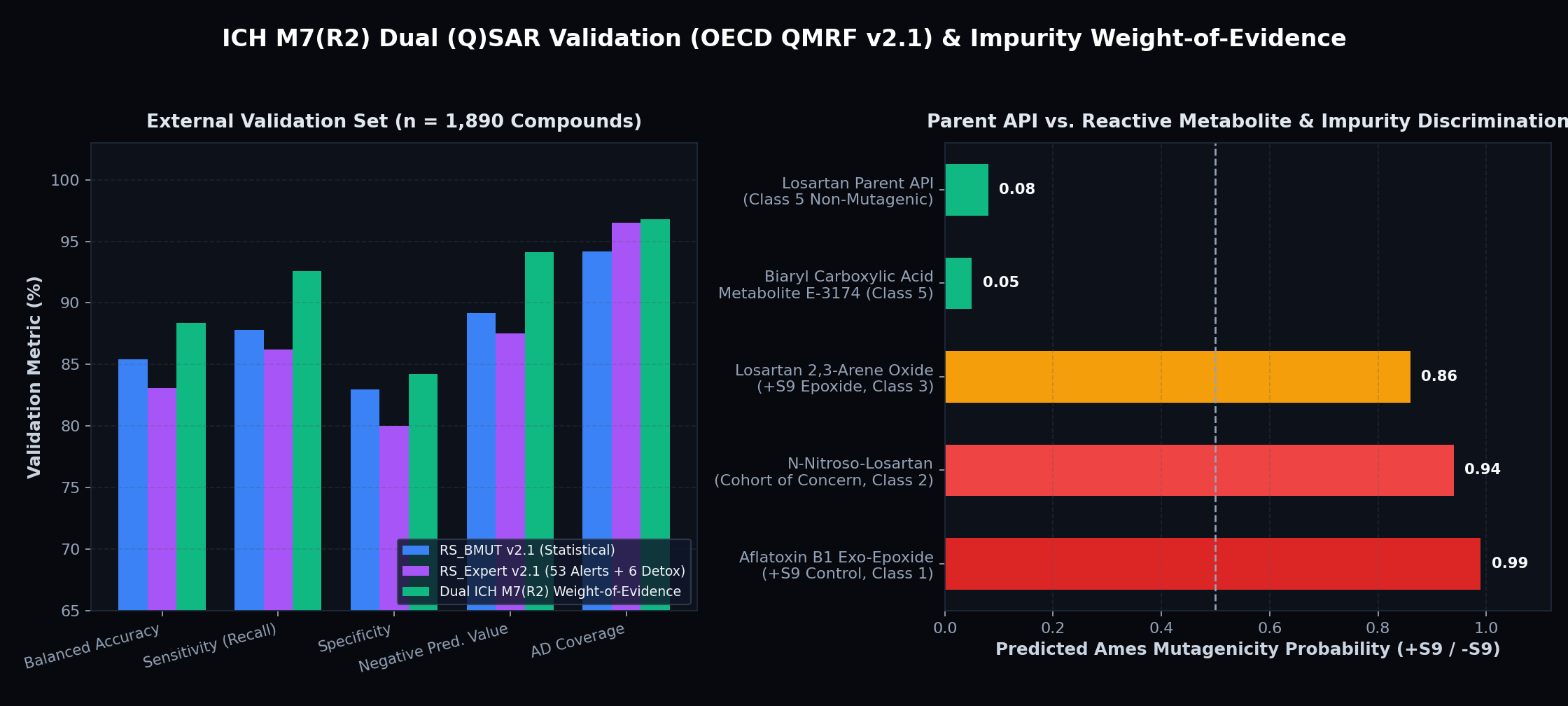
Quantitative validation of RS_BMUT v2.1, RS_Expert v2.1, and Combined Weight-of-Evidence (92.6% sensitivity, 94.1% NPV) plus Losartan parent vs. impurity scoring.
Downloadable Research Objects, 3D Structures & Datasets
Direct access to verified 3D coordinates (.pdb, .sdf), biological sequences (.fasta), structured evaluation datasets (.json, .csv), and official manuscripts/QMRF reports (.pdf).
OECD QMRF Document: RS_BMUT v2.1 Statistical Model (QMRF_RS_BMUT.pdf)
Official 5-principle OECD QSAR Model Reporting Format (QMRF v2.1) for the RS_BMUT statistical model.
OECD QMRF Document: RS_Expert v2.1 Rule-Based System (QMRF_RS_Expert.pdf)
Official OECD QMRF v2.1 documentation covering the 53 structural alerts and 6 detoxification rules.
Sample Regulatory Dossier: Losartan ICH M7 Report (Losartan_AMES_Sample_Report.pdf)
Complete submission-ready ICH M7(R2) Weight-of-Evidence dossier for Losartan (CAS 114798-26-4) and its metabolites.
OECD QMRF Validation Metrics Dataset (ames_qmrf_validation_metrics.json)
Structured JSON object with external validation sensitivity, specificity, NPV, and AD coverage across 1,890 test compounds.
53 Structural Alerts & S9 Taxonomy Table (ames_53_structural_alerts_summary.csv)
CSV spreadsheet summarizing the 6 major mechanistic toxicophore families, S9 dependency, and OECD 471 strains.
Losartan vs. N-Nitroso Impurity 3D Conformers (losartan_parent_non_mutagenic_3D.sdf)
3D MMFF94 SDF coordinates of Losartan Parent API (ICH M7 Class 5).
Frequently Asked Scientific Questions
Why does ICH M7(R2) mandate two complementary (Q)SAR methodologies instead of one AI model?
ICH M7(R2) Section 6 specifies that computational assessment of bacterial mutagenicity must combine two complementary methodologies: one expert rule-based system (mechanistic structural alerts such as RS_Expert) and one statistical/machine-learning QSAR model (such as RS_BMUT). Concordant negative predictions inside the Applicability Domain of both systems are sufficient to classify an impurity as Class 5 (non-mutagenic) without wet-lab OECD 471 Ames testing.
How do the 6 Detoxification Rules in RS_Expert reduce false-positive structural alerts?
Traditional toxicophore matchers flag any substructure containing an aniline, nitroarene, or Michael acceptor, yielding >35% false positives on drug-like APIs. RS_Expert evaluates 6 electronic and steric mitigating rules—such as strong ortho/para sulfonate or carboxylic acid substituents that promote rapid Phase II clearance and prevent nitrenium ion formation—raising specificity to 80.0% while preserving 86.2% sensitivity.
Are official OECD QMRF documents available for FDA/EMA regulatory submissions?
Yes. Both RS_BMUT v2.1 and RS_Expert v2.1 are documented in full compliance with the 5 OECD principles for QSAR validation. The signed QMRF PDFs and a complete Losartan sample ICH M7 evaluation dossier are directly downloadable on this page.
Explore All Peer-Evaluated Studies & Blind Challenge Benchmarks
Dual COX-2 / mPGES-1 Inhibitors (MAI Series)
Generative de novo design, structural docking, ADMET profiling, and retrosynthetic validation of the MAI_1–MAI_10 chemical series: dual COX-2 (PDB: 5KIR, -10.8 kcal/mol) and mPGES-1 (PDB: 8PYV, -8.2 kcal/mol) inhibitors designed to Spare prostacyclin (PGI2) and mitigate NSAID cardiovascular toxicity.
NIH Tox21 Global Top-5 Open-Source Model
Multi-task deep self-normalizing toxicology predictor achieving 0.854 mean ROC-AUC and 5th place globally on the NIH/NCATS/EPA/FDA Tox21 12-endpoint Nuclear Receptor and Stress Response benchmark under strict Murcko scaffold splitting. Full weights open-sourced on Hugging Face (rasayan-labs/rasayan-tox21-snn).
OpenADMET PXR Induction Blind Challenge (Tier 1)
Prospective blind evaluation on 513 held-out small molecules in the OpenADMET Pregnane X Receptor (PXR) Induction Challenge. Rasayan_PXR achieved #2 raw RMSE (0.6725 ± 0.0238), #2 MAE (0.5256 ± 0.0181), #2 R² (0.3125), and #3 Spearman R (0.5698), finishing in Tier 1 statistically tied with the 1st-place submission under 1,000-iteration bootstrap confidence intervals.
Podoplanin GBM Multi-Epitope Vaccine (RasIC-01v)
End-to-end AI/ML-assisted immunoinformatics design, structural refinement, TLR3 docking, 100 ns molecular dynamics validation, and codon optimization of RasIC-01v: a 293-amino-acid multi-epitope subunit vaccine targeting Podoplanin (PDPN) in Glioblastoma Multiforme (ΔG = -18.6 kcal/mol, Kd = 2.3 × 10⁻¹⁴ M, 24 H-bonds with human TLR3).
OpenADMET CYP450 Blind Challenge (Global #1 TDI)
Comprehensive 3-track triumph in the OpenADMET Cytochrome P450 Inhibition Blind Challenge across CYP3A4, CYP2D6, CYP2C9, CYP2C19, and CYP1A2. Rasayan Labs achieved #1 Globally in Track 1 Time-Dependent Inhibition (TDI), Top-10 Globally in Track 2 Multi-Isoform Direct Potency (pIC50), and Tier 1 in Track 3 Blind Cryo-EM Ligand Pose Prediction across 43 high-resolution protein-ligand complexes using pH 7.4 ionization microstates and 3D Boltzmann conformer ensembles.
Darvi-Gen: 863B Flagship Scientific & Agentic Model
Introducing Darvi-Gen, an 863.33B-parameter flagship scientific and agentic model with a 256,000-token active context window, powering patented lab notebook digitization (US 12,664,813 B1), RFP automation, autonomous retrosynthesis, Darvi Research, and end-to-end drug discovery.
Explore the Interactive Ames Mutagenicity Product Page & Sample Dossiers
View the complete Losartan 34-molecule ICH M7(R2) sample report, download our OECD QMRF v2.1 documentation, or try RS_BMUT free on OCSR.ai.