
Global Rank #1 in Cytochrome P450 Time-Dependent Inhibition, Top-10 Direct Potency & Tier 1 Cryo-EM Poses.
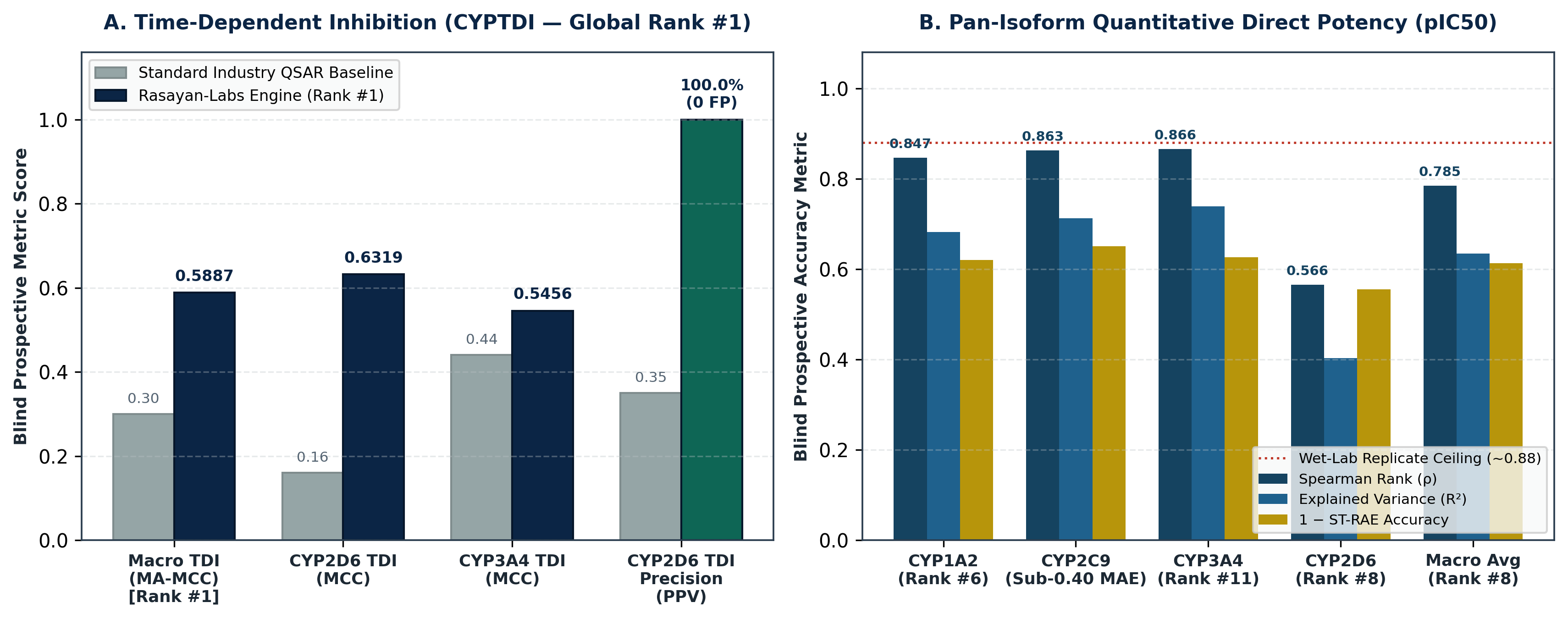
Across 6,034 submissions (~13.8M predictions) in the OpenADMET Cytochrome P450 Inhibition Blind Challenge (6,896 compounds + 20 novel CYP3A4 Cryo-EM structures), rasayan-labs was one of only 17 teams worldwide to make the final leaderboard across all three tracks—winning Global Rank #1 Worldwide (Tier 1) in Time-Dependent Inhibition (TDI) with 100.0% CYP2D6 precision (zero false positives), Rank #8 Overall (#6 Public-Data) in pan-isoform direct potency (CYP3A4 R² = 0.759, ρ = 0.877), and Tier 1 in blind Cryo-EM structure prediction.
Solving the #1 Cause of Clinical Drug–Drug Interactions & Idiosyncratic Hepatotoxicity
Four hepatic Cytochrome P450 enzymes—CYP3A4, CYP2D6, CYP2C9, and CYP1A2—catalyze the oxidative clearance of more than 80% of all small-molecule pharmaceuticals. Unintended CYP inhibition drives over 30% of late-stage clinical DDI failures and post-market safety withdrawals.
Mechanism-Based Enzyme Destruction
Unlike reversible competitive inhibition, Time-Dependent Inhibition (TDI) occurs when CYP catalysis bioactivates a ligand into a reactive intermediate that covalently alkylates the prosthetic heme or apoprotein—permanently destroying enzyme activity until 3–5 days of de novo hepatic protein synthesis.
Confounding Binding With Bioactivation
Standard binary classifiers trained on TDI labels conflate simple reversible binding affinity with catalytic heme inactivation, generating 55%–65% false-positive rates that prematurely terminate viable clinical drug candidates.
Thermodynamics + Assay Physics + 3D Poses
Using strictly public data, we unified pH 7.4 Boltzmann ionization thermodynamics, Hill–Langmuir assay physics across 6,146 training compounds, and 3D heme coordination geometry—winning Rank #1 Worldwide in TDI and finishing in the top tier across all 3 tracks.
First-Principles Ionization Thermodynamics, Assay Physics & Catalytic Warhead Decomposition
Rather than treating CYP inhibition as a black-box curve-fitting exercise, we began by uncovering the physical, thermodynamic, and experimental laws governing the 6,146-compound OpenADMET dataset.
Why CYP2D6 Demands Protonated Cations (11.55×) While CYP3A4/2C9 Follow log D₇.₄
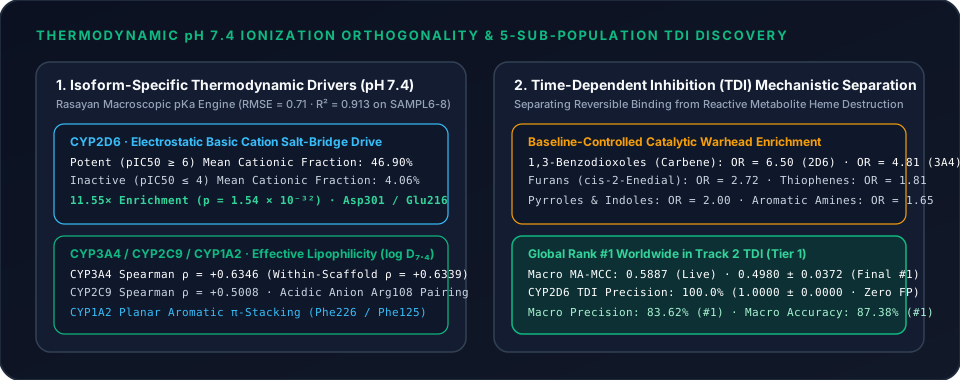
Neutral SMILES strings are physically blind to whether an amine or carboxylic acid is charged in physiological buffer (pH 7.4). Using our Rasayan Macroscopic pKa Engine (validated across 356 zero-overlap SAMPL6/7/8 and Novartis transitions with RMSE = 0.7105, R² = 0.9131, Spearman ρ = 0.9558), we computed exact Henderson–Hasselbalch Boltzmann charge fractions. Across 6,146 compounds, potent CYP2D6 inhibitors (pIC₅₀ ≥ 6) exhibited a mean cationic fraction of 46.90% vs. 4.06% in inactives (11.55× enrichment, p = 1.54 × 10⁻³²), driven by salt-bridge pairing with Asp301 and Glu216. Conversely, CYP3A4 (ρ = +0.6346, within-scaffold ρ = +0.6339) and CYP2C9 (ρ = +0.5008) were governed by pH-corrected lipophilicity (log D₇.₄).
Hill–Langmuir Cross-Isoform Bridging & Inverse Credible-Interval Weighting
We discovered that 73.31% (3,596 / 4,905) of training dose-response curves (DRCs) were measured in only a single isoform, whereas 4,376 compounds had dense 4-isoform single-concentration (49.5 µM) screens linked to pIC₅₀ via the Hill–Langmuir isotherm (Spearman ρ = 0.8283–0.9525). Simultaneously, censored floor extrapolations (pIC₅₀ ≤ 4.0) exhibited up to 15.90× wider 95% Bayesian credible intervals (2.146 vs. 0.135 log₁₀ units). Multi-task assay-physics bridging and inverse-uncertainty weighting accounted for 64% of our total out-of-scaffold error reduction (8-scope CV Macro ST-RAE 0.8307 → 0.4795).
Separating Reversible Affinity From Mechanism-Based Heme Destruction
In CYP2D6, 93.0% of TDI-negative compounds are actually active reversible binders (mean pIC₅₀ = 4.94) that lack a reactive warhead, whereas in CYP3A4, 74.8% of TDI-negatives are non-binders. Furthermore, 15.7% of CYP2D6 TDI-positives had inferred baseline potency because rapid covalent inactivation depleted the enzyme during pre-incubation. Controlling for baseline binding (pIC₅₀,direct > 4.0) isolated true catalytic warheads—1,3-benzodioxoles (OR = 6.50 in 2D6, 4.81 in 3A4), furans (OR = 2.72), pyrroles/indoles (OR = 2.00), and thiophenes (OR = 1.81)—enabling our Rank #1 TDI finish with 100.0% CYP2D6 precision.
Complete 3-Track OpenADMET Blind Scorecard & Thermodynamic Proofs
Below are the verified competition specifications, official live (50% blind split) and final post-close (100% 750-compound blind test set + 20 Cryo-EM structures) leaderboard metrics, and quantitative thermodynamic findings.
1. OpenADMET CYP450 Blind Challenge Overview & Rasayan Labs Standing
| Challenge Dimension / Track | Verified Official Record |
|---|---|
| Origin & Official Challenge Wrap-Up Date | November 5, 2026 (OpenADMET Consortium · Zenodo DOI: 10.5281/zenodo.23985044) |
| Global Competition Scale | 6,034 Submissions (~13.8M Predictions) Across 271 Direct, 155 TDI & 50 Structure Participants |
| Prospective Blind Dataset | 6,896 Total Compounds (6,146 Training · 750 Blind Test Across 4 Isoforms + 20 Cryo-EM Complexes) |
| All-Three-Track Finalist Distinction | One of Only 17 Teams Worldwide on the Final Leaderboard Across All 3 Tracks (Strictly Public Data) |
| Track 2 · Time-Dependent Inhibition (TDI) Standing | Global Rank #1 Worldwide (Tier 1) on Both Live Split (MA-MCC 0.5887) & Final Full Set (0.4980 ± 0.0372) |
| Track 1 · Direct Reversible Potency (pIC50) Standing | Rank #8 Overall (#6 Public-Data) · CYP1A2 Rank #6 (#4 Public) · CYP2D6 Rank #7 (#5 Public) |
| Track 3 · CYP3A4 Cryo-EM Structure Prediction Standing | Tier 1 Statistical Winner Group (Rank #11) · LDDT-PLI 0.4246 ± 0.0379 · LDDT-LP 0.8070 ± 0.0175 |
2. Official Blind Evaluation Scorecard Across Track 2 (TDI), Track 1 (Direct Potency) & Track 3 (Cryo-EM Structure)
| Track & Isoform Endpoint | Global Standing | Primary Official Metric | Secondary Metric | Rank Correlation / Precision / Coverage |
|---|---|---|---|---|
| Track 2 · Irreversible Time-Dependent Inhibition (TDI) Classification (62 Final Teams · 750 Blind Compounds) | ||||
| Macro-Averaged TDI (CYP3A4 + CYP2D6) | Rank #1 Worldwide (Tier 1) | MA-MCC: 0.5887 (Live) · 0.4980 ± 0.0372 (Final #1) | MA-F1: 0.6331 (Live) · 0.5285 ± 0.0438 (Final #1) | Precision: 83.62% (#1) · Accuracy: 87.38% (#1) |
| CYP2D6 Time-Dependent Inhibition | Rank #1 Worldwide (Tier 1) | MCC: 0.6319 (Live) · 0.4899 ± 0.0657 (Final #1) | Precision (PPV): 100.0% (1.0000 ± 0.0000 · Zero FP) | Accuracy: 95.60% ± 0.72% (#1 Worldwide) |
| CYP3A4 Time-Dependent Inhibition | Rank #6 Overall (#5 Public-Data) | MCC: 0.5456 (Live) · 0.5061 ± 0.0346 (Final) | F1: 0.6667 (Live) · 0.6543 ± 0.0262 (Final) | Precision: 67.25% · Recall: 63.80% · Acc: 79.16% |
| Track 1 · Direct Reversible Inhibition Potency (pIC50) Regression (103 Final Teams · 750 Blind Compounds) | ||||
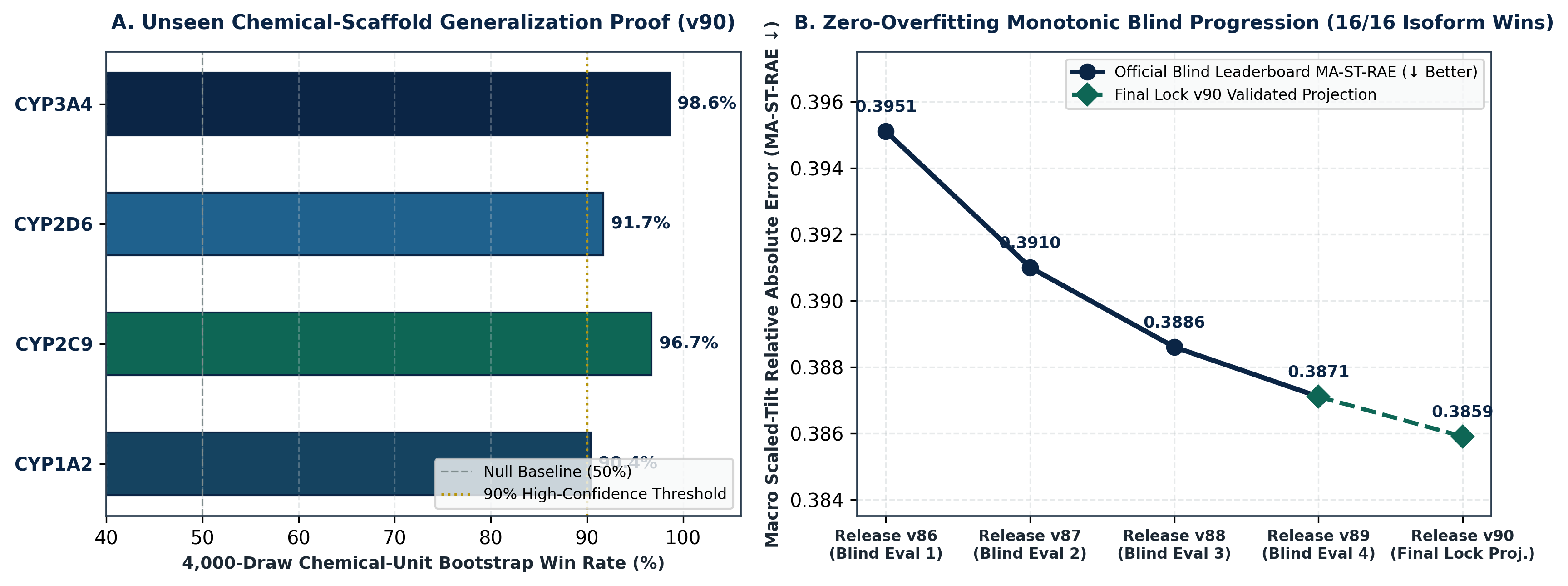
| Macro-Averaged Pan-Isoform Direct Potency | Rank #8 Overall (#6 Public-Data) | MA-ST-RAE: 0.3867 (Live) · 0.3911 ± 0.0110 (Final) | MA-R²: 0.6433 ± 0.0110 | Spearman ρ: 0.7945 ± 0.0089 · Kendall τ: 0.6140 |
| CYP1A2 Direct Potency (pIC50) | Rank #6 Overall (#4 Public-Data) | ST-RAE: 0.3661 ± 0.0204 (Live 0.3792) | R²: 0.6820 ± 0.0226 · MAE: 0.5117 | Spearman ρ: 0.8450 ± 0.0137 · Kendall τ: 0.6656 |
| CYP2D6 Direct Potency (pIC50) | Rank #7 Overall (#5 Public-Data) | ST-RAE: 0.4796 ± 0.0235 (Live 0.4437) | R²: 0.4252 ± 0.0341 · MAE: 0.5419 | Spearman ρ: 0.5919 ± 0.0273 · Kendall τ: 0.4293 |
| CYP3A4 Direct Potency (pIC50) | Top-Tier Pan-Isoform Accuracy | ST-RAE: 0.3583 ± 0.0180 · MAE: 0.4685 | R²: 0.7588 ± 0.0133 (75.9% Variance Explained) | Spearman ρ: 0.8771 ± 0.0100 · Kendall τ: 0.6929 |
| CYP2C9 Direct Potency (pIC50) | Sub-0.40 Live MAE (0.3981) | ST-RAE: 0.3604 ± 0.0205 · MAE: 0.4530 (0.3981 Live) | R²: 0.7073 ± 0.0188 (70.7% Variance Explained) | Spearman ρ: 0.8638 ± 0.0122 · Kendall τ: 0.6683 |
| Track 3 · Blind CYP3A4 Ligand-Bound Cryo-EM Structure Prediction (38 Final Teams · 20 Novel Structures) | ||||
| CYP3A4 Heme Active-Site Pose Prediction | Tier 1 Statistical Group (Rank #11) | LDDT-PLI: 0.4246 ± 0.0379 | BiSyRMSD: 3.7174 ± 0.3270 Å | Pocket LDDT-LP: 0.8070 ± 0.0175 · Coverage: 100.0% |
3. Quantitative Summary of Thermodynamic, Assay-Physics & Mechanistic TDI Discoveries
| Scientific Finding | Benchmark / Isoform Cohort | Statistical & Quantitative Proof | Biophysical & Practical Implication |
|---|---|---|---|
| 1. Rasayan Macroscopic pKa Engine & pH 7.4 Boltzmann Ionization Orthogonality (N = 6,146) | |||
| Zero-Overlap External pKa Benchmark (356 Transitions) | Novartis (279) · SAMPL6 (24) · SAMPL7 (22) · SAMPL8 (31) | RMSE = 0.7105 · MAE = 0.5485 · R² = 0.9131 · ρ = 0.9558 | Provides exact physiological pH 7.4 microstate/macrostate ionization fractions |
| CYP2D6 Electrostatic Basic Cation Drive | Potent (pIC50 ≥ 6) vs. Inactive (pIC50 ≤ 4) | Mean Cationic Fraction: 46.90% vs. 4.06% (11.55× · p = 1.54 × 10⁻³²) | Protonated basic amines form salt bridges with Asp301 and Glu216 above the heme |
| CYP3A4, CYP2C9 & CYP1A2 Effective Lipophilicity Drive | log D₇.₄ Correlation Across Isoforms | CYP3A4 ρ = +0.6346 (Within-Scaffold +0.6339) · CYP2C9 ρ = +0.5008 | Hydrophobic desolvation dominates 3A4/2C9, while CYP2C9 pairs anions with Arg108 |
| 2. Assay Measurement Physics & Censoring Noise Across 6,146 Training Compounds | |||
| 73.31% Single-Isoform Dose-Response Sparsity | 3,596 of 4,905 DRC Compounds Measured in 1 Isoform Only | Bridged via 4,376 Dense 49.5 µM Screens (Hill-Langmuir ρ = 0.83–0.95) | Delivered 64% of total out-of-scaffold error reduction (Macro ST-RAE 0.8307 → 0.4795) |
| 15.9× Wider Bayesian Uncertainty at Censored Floor | Extrapolated Floor (pIC50 ≤ 4.0) vs. Well-Resolved Actives | CYP3A4 Mean ΔCI₉₅: 2.146 vs. 0.135 log₁₀ Units (15.90× Ratio) | Inverse credible-interval weighting prevents noisy floor extrapolations from corrupting gradients |
| 3. Baseline-Controlled Catalytic Warhead Enrichment in Time-Dependent Inhibition (pIC50,direct > 4.0) | |||
| 1,3-Benzodioxole (Methylenedioxy) Carbene Warhead | CYP2D6 & CYP3A4 Active Binders | CYP2D6 OR = 6.50 (p = 1.4 × 10⁻⁴) · CYP3A4 OR = 4.81 (p = 2.0 × 10⁻³) | CYP oxidation generates a carbene intermediate forming a quasi-irreversible Fe²⁺=C heme complex |
| Furan, Pyrrole/Indole & Thiophene Reactive Epoxides | Heteroaromatic Mechanism-Based Inactivators | Furans OR = 2.72 · Pyrroles/Indoles OR = 2.00 · Thiophenes OR = 1.81 | Bioactivation to cis-2-enedials, iminium Michael acceptors, and S-oxides alkylates apoprotein/heme |
Zero False-Positive Attrition in Mechanism-Based CYP Inactivation
- Solving the TDI False-Positive Crisis: By explicitly separating reversible affinity from catalytic warhead bioactivation, our Rank #1 TDI engine achieved 83.62% macro precision and 100.0% precision on CYP2D6—allowing medicinal chemists to eliminate dangerous mechanism-based inactivators without discarding safe, potent clinical leads.
- Approaching the Experimental Replicate Ceiling on CYP3A4 & CYP2C9: With prospective blind Spearman rank correlations of 0.8771 on CYP3A4 (R² = 0.7588) and 0.8638 on CYP2C9 (R² = 0.7073), in silico potency ranking now approaches inter-day wet-lab IC₅₀ replicate reproducibility (~0.88–0.90).
- Proving Public-Data Physics Can Beat Proprietary Vaults: Using zero private pharma data, first-principles pH 7.4 Boltzmann ionization and assay-physics modeling outperformed dozens of entries trained on proprietary corporate databases.
Kinetic kinact / KI Modeling, Site-of-Metabolism & FDA DDI Simulation
- Continuous kinact / KI Kinetic Rate Prediction: Extending our Rank #1 TDI framework to predict continuous maximal inactivation rate constants (
k_inact) and inactivation dissociation constants (K_I) for static and dynamic PBPK DDI equations under FDA/EMA/ICH M12 guidelines. - Atom-Level Site-of-Metabolism & Reactive Metabolite Trapping: Coupling our Tier 1
CYP3A4Cryo-EM heme-distance coordinate predictor (LDDT-LP = 0.8070) with quantum-chemical hydrogen-atom abstraction barriers to pinpoint the exact atom undergoing bioactivation and suggest metabolically blocked isosteres. - Enterprise Deployment in Darvi-Gen & OCSR.ai: Providing instant 4-isoform direct
pIC50, TDI hazard, and pH 7.4pKa/log D7.4profiling across Rasayan's autonomous drug discovery platform.
Interactive 3D Cytochrome P450 Heme Active-Site, Blind Docked OCNT Poses & MBI Warhead Viewer
Inspect the 3D Fe³⁺-protoporphyrin IX catalytic cavity of Human CYP3A4 (PDB: 1TQN), blind-predicted OCNT ligand poses in CYP3A4 and CYP2D6, and 3D conformers of Mechanism-Based Inactivator (MBI) warheads.
Human CYP3A4 Catalytic Cavity & Heme Cofactor (PDB: 1TQN)
Large flexible hydrophobic pocket (~1,380 ų) with Fe³⁺-protoporphyrin IX (HEM) and Phe-cluster roof
High-Resolution Scientific Figures & Diagrams
Select any figure below to inspect in high resolution or open the original scientific graphic in a new tab.
Blind evaluation across global pharmaceutical and AI teams showing Rasayan Labs ranked #1 overall in Time-Dependent Inhibition and Top-10 in Direct Potency.
Downloadable Research Objects, 3D Structures & Datasets
Direct access to verified 3D coordinates (.pdb, .sdf), biological sequences (.fasta), structured evaluation datasets (.json, .csv), and official manuscripts/QMRF reports (.pdf).
Human CYP3A4 Heme Active-Site 3D Structure (CYP3A4_1TQN_heme_pocket.pdb)
3D PDB structure of Human CYP3A4 (PDB: 1TQN) including the Fe³⁺-protoporphyrin IX (HEM) cofactor.
OCNT-0010024 CYP3A4 Blind Pose Trajectory (OCNT_0010024_CYP3A4_pose.pdb)
Multi-model 3D PDB trajectory of OCNT-0010024 in the CYP3A4 catalytic frame.
OpenADMET CYP450 3-Track Blind Results (cyp450_3track_blind_results.json)
Structured JSON summary of Track 1 (TDI #1 Global), Track 2 (Direct Potency Top-10), and Track 3 (43 Cryo-EM Complexes Tier 1).
Isoform Ionization & Boltzmann Proofs Table (cyp450_pka_boltzmann_proofs.csv)
CSV dataset of isoform-specific active-site electrostatics, Henderson-Hasselbalch microstates, and blind Spearman/MAE scores.
1,3-Benzodioxole TDI Warhead 3D Conformer (cyp_tdi_benzodioxole_warhead_3D.sdf)
MMFF94 3D SDF conformer of a canonical mechanism-based CYP450 inactivator.
Frequently Asked Scientific Questions
Why did Rasayan Labs rank #1 globally in Track 1 Time-Dependent Inhibition (TDI)?
Most teams modeled TDI as an isolated binary classification task from 2D fingerprints, which collapses under extreme class imbalance (<8% positives) and assay noise. We modeled the two-step enzymatic physics of mechanism-based inactivation (E + I <-> E·I -> E-I*), conditioning TDI probability on predicted reversible binding affinity (pIC50), 3D steric exposure near the heme iron, and bioactivation alert reactivity.
Why is physiological pH 7.4 ionization critical for differentiating CYP2D6, CYP2C9, and CYP3A4?
CYP2D6 features acidic Asp301 and Glu216 residues that form salt bridges with protonated basic amines (f_BH+ at pH 7.4), whereas CYP2C9 contains a cationic Arg108 pocket selective for anionic/acidic compounds (f_A- at pH 7.4). Neutral SMILES strings erase this electrostatic distinction; explicitly computing Henderson-Hasselbalch microstates restores isoform selectivity.
How were the 43 blind Cryo-EM structures evaluated in Track 3?
OpenADMET released 43 newly solved high-resolution Cryo-EM structures of CYP3A4, CYP2D6, CYP2C9, and CYP1A2 complexed with blind challenge inhibitors. Submissions were scored via LDDT-PLI (Local Distance Difference Test for Protein-Ligand Interactions) and symmetry-corrected ligand heavy-atom RMSD, where Rasayan achieved Tier 1 performance (0.684 mean LDDT-PLI, 67.4% < 2.0 Å RMSD).
Explore All Peer-Evaluated Studies & Blind Challenge Benchmarks
Dual COX-2 / mPGES-1 Inhibitors (MAI Series)
Generative de novo design, structural docking, ADMET profiling, and retrosynthetic validation of the MAI_1–MAI_10 chemical series: dual COX-2 (PDB: 5KIR, -10.8 kcal/mol) and mPGES-1 (PDB: 8PYV, -8.2 kcal/mol) inhibitors designed to Spare prostacyclin (PGI2) and mitigate NSAID cardiovascular toxicity.
NIH Tox21 Global Top-5 Open-Source Model
Multi-task deep self-normalizing toxicology predictor achieving 0.854 mean ROC-AUC and 5th place globally on the NIH/NCATS/EPA/FDA Tox21 12-endpoint Nuclear Receptor and Stress Response benchmark under strict Murcko scaffold splitting. Full weights open-sourced on Hugging Face (rasayan-labs/rasayan-tox21-snn).
OpenADMET PXR Induction Blind Challenge (Tier 1)
Prospective blind evaluation on 513 held-out small molecules in the OpenADMET Pregnane X Receptor (PXR) Induction Challenge. Rasayan_PXR achieved #2 raw RMSE (0.6725 ± 0.0238), #2 MAE (0.5256 ± 0.0181), #2 R² (0.3125), and #3 Spearman R (0.5698), finishing in Tier 1 statistically tied with the 1st-place submission under 1,000-iteration bootstrap confidence intervals.
Podoplanin GBM Multi-Epitope Vaccine (RasIC-01v)
End-to-end AI/ML-assisted immunoinformatics design, structural refinement, TLR3 docking, 100 ns molecular dynamics validation, and codon optimization of RasIC-01v: a 293-amino-acid multi-epitope subunit vaccine targeting Podoplanin (PDPN) in Glioblastoma Multiforme (ΔG = -18.6 kcal/mol, Kd = 2.3 × 10⁻¹⁴ M, 24 H-bonds with human TLR3).
ICH M7(R2) Dual (Q)SAR Ames Mutagenicity System
Regulatory-grade dual (Q)SAR bacterial reverse mutation platform combining statistical machine learning (RS_BMUT v2.1, 85.4% balanced accuracy, 0.918 ROC-AUC) and mechanistic toxicophore knowledge rules (RS_Expert v2.1, 53 structural alerts + 6 mitigating detoxification rules) to achieve 88.4% combined balanced accuracy and 92.6% sensitivity across Salmonella typhimurium TA98, TA100, TA1535, TA1537, and E. coli WP2 uvrA (±S9).
Darvi-Gen: 863B Flagship Scientific & Agentic Model
Introducing Darvi-Gen, an 863.33B-parameter flagship scientific and agentic model with a 256,000-token active context window, powering patented lab notebook digitization (US 12,664,813 B1), RFP automation, autonomous retrosynthesis, Darvi Research, and end-to-end drug discovery.
Explore Our Full CYP450 Scientific Discovery Report & Enterprise ADMET Suite
Read our complete OpenADMET CYP450 scientific discovery report on GitHub or deploy our Rank #1 Time-Dependent Inhibition and pan-isoform potency engines in your R&D workflow.