
98.31% on Chemistry Olympiad Problems
Evaluated as a raw 863.33-billion-parameter foundation model with a 256,000-token context window and mid-research symbolic verification.
General-purpose large language models are fluent writers, but conversational fluency is not scientific validity. When asked to reconcile conflicting IC50 tables across forty patent families, balance a multi-step redox cascade, or select a protecting-group strategy for a sterically hindered intermediate, generic chatbots routinely write confident prose while violating reaction stoichiometry or fabricating literature citations.
In drug discovery and process chemistry, an unverified guess is worse than no answer at all because a single misread molar equivalent or hallucinated patent claim can send a synthetic campaign down an expensive dead end. To be reliable at the bench, an AI system must treat every molecular graph, spectral multiplet, and thermodynamic quantity as a verifiable physical object.
That requirement drove the engineering of Darvi-Gen, our 863.33-billion-parameter scientific and agentic foundation model built with a native 256,000-token context window and served across a high-availability cluster at 1,696.2 tokens per second.
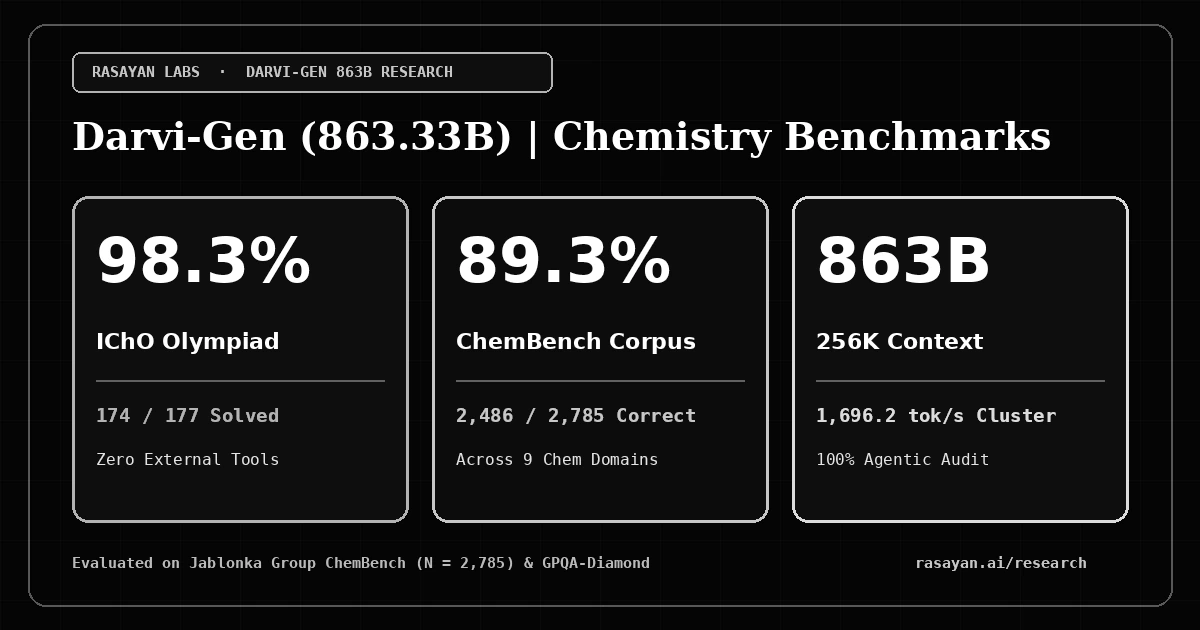
Zero-Tool Evaluation Across the 2,785-Question ChemBench Suite
When evaluating scientific language models, many published benchmarks allow the model to call external Python interpreters or calculators during testing, which can mask shallow underlying chemical intuition. To measure what Darvi-Gen understands natively in its weights, we evaluated the raw foundation model with zero external tools across the complete 2,785-question ChemBench benchmark suite developed by the Jablonka Group.
Across all 2,785 ChemBench problems spanning nine sub-disciplines of chemistry, Darvi-Gen answered 2,486 correctly for an overall zero-tool accuracy of 89.26%. On the International Chemistry Olympiad (IChO) subset, which tests multi-step quantitative synthesis and physical chemistry reasoning, the raw model solved 174 of 177 problems (98.31%), alongside 95.19% on the Oxford University Press (OUP) university textbook split.
Across individual chemistry sub-disciplines, Darvi-Gen recorded 94.63% in General Chemistry, 93.48% in Inorganic Chemistry, 91.14% in Organic Chemistry, 89.81% in Analytical Chemistry, and 88.39% in Physical Chemistry. On broader doctoral reasoning and engineering suites, Darvi-Gen achieved 91.7% on GPQA-Diamond, 96.7% on AIME 2026, and 83.3% on SWE-Bench Verified.
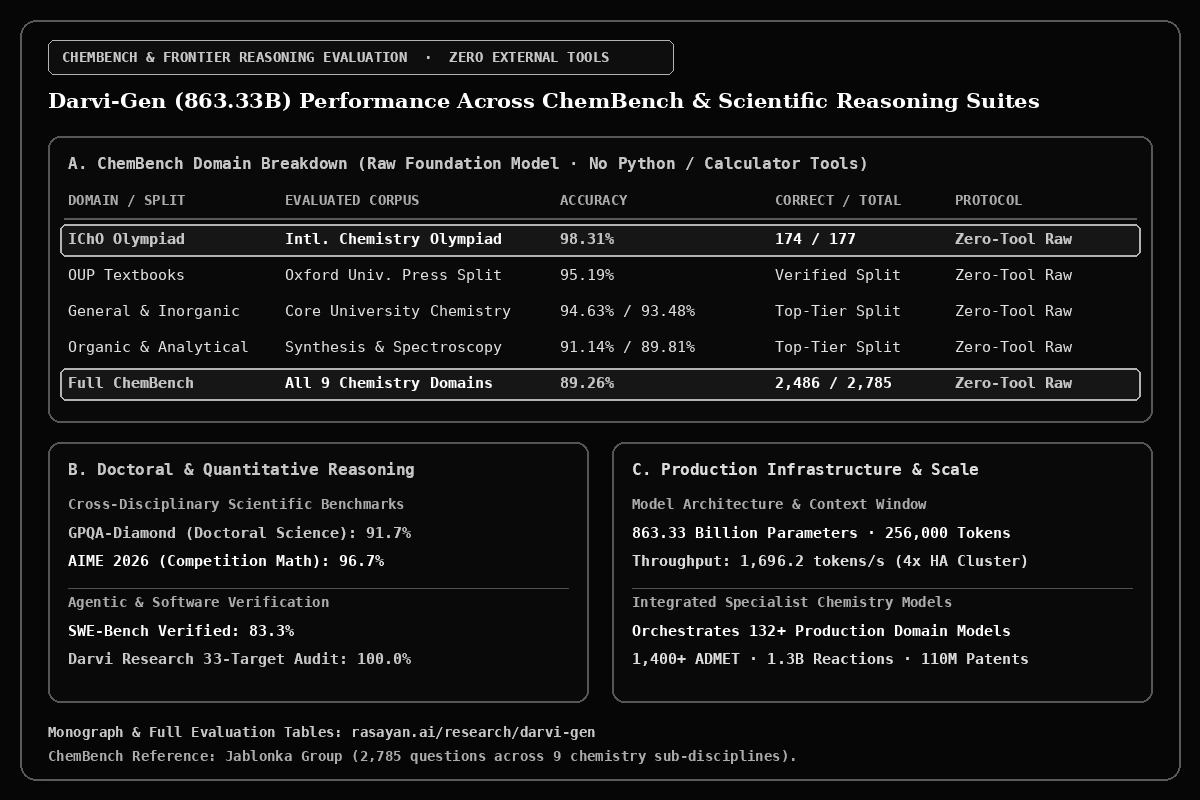
ChemBench 9-Domain Breakdown (2,785 Questions · Zero External Tools)89.26% Overall · 98.31% IChO▾
Doctoral Science, Competition Mathematics & Software Engineering91.7% GPQA · 96.7% AIME▾
How Mid-Research Symbolic Verification Prevents Hallucinations
High raw benchmark accuracy is necessary but not sufficient for autonomous pharmaceutical research. When synthesizing evidence across dozens of patents or designing a multi-step synthesis route, an agent must verify every intermediate calculation before committing to a conclusion.
Inside the Darvi Research architecture, Darvi-Gen operates within a multi-wave verification loop. Before generating a final report, the model decomposes the scientific query into testable hypotheses, checks reaction mass balance and redox electron counts symbolically, reconciles assay units across primary patent tables within its 256,000-token context window, and orchestrates over 132 specialized production models across retrosynthesis, OCSR, and 1,400+ ADMET endpoints.
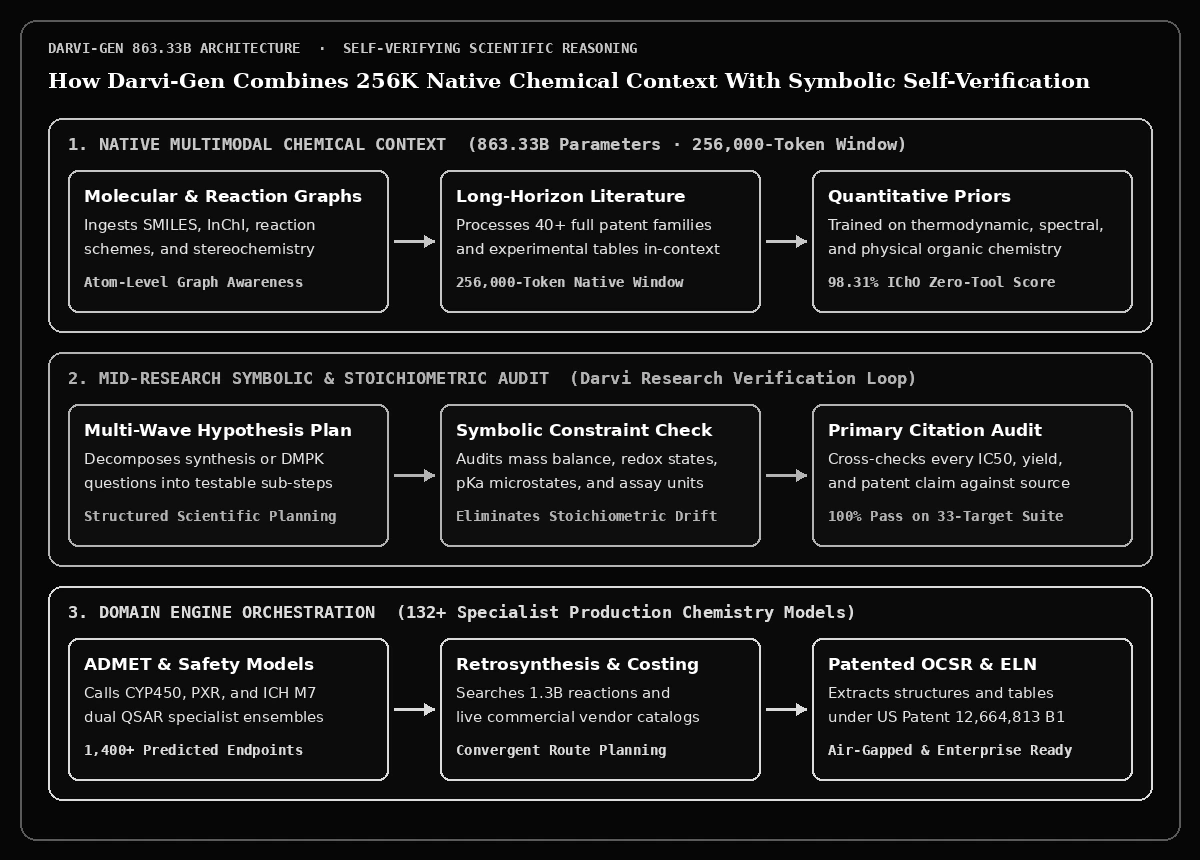
What This Means for Enterprise Drug Discovery and Process R&D
Across our 33-target quantitative drug-discovery verification suite, the Darvi Research agentic engine achieved a 100.0% verified pass rate. For pharmaceutical R&D organizations, Darvi-Gen can be deployed inside private cloud VPCs or air-gapped on-premise clusters, uniting literature intelligence, freedom-to-operate patent analysis, retrosynthetic route planning, and predictive DMPK under a single verifiable foundation model.
Explore our technical monographs and documentation, or connect directly with Rasayan Labs.