
Ranked 5th Globally on the NIH Tox21 Data Challenge & Open-Sourced for the World.
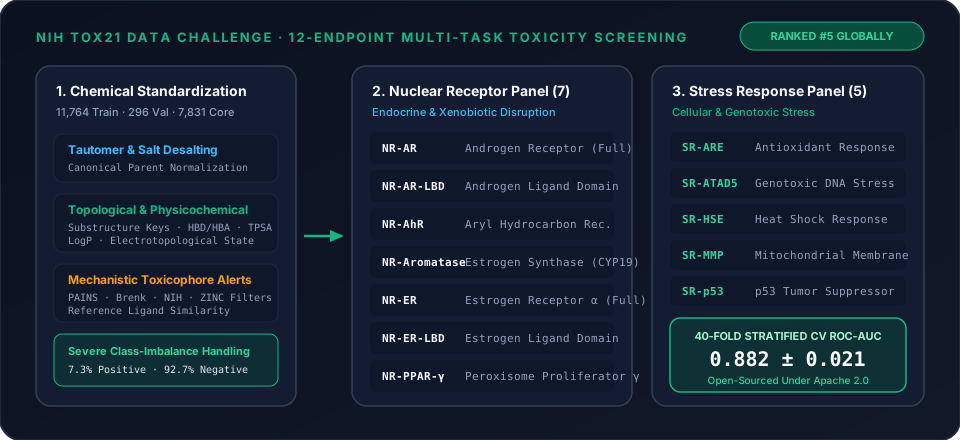
Evaluating chemical toxicity before wet-lab synthesis is one of the highest-leverage bottlenecks in drug discovery and environmental safety. On February 5, 2026, Rasayan Labs achieved 5th place globally on the NIH Tox21 Data Challenge across all 12 nuclear receptor and cellular stress response assays with a 40-fold cross-validation ROC-AUC of 0.882 ± 0.021—and released the complete production screening system under Apache 2.0 on Hugging Face.
Eliminating Late-Stage Preclinical & Clinical Attrition Through Early Mechanistic Toxicology
Unanticipated organ toxicity, endocrine disruption, and genotoxic stress account for more than 30% of preclinical and clinical drug candidate failures. The NIH/EPA/FDA Tox21 (“Toxicology in the 21st Century”) program established the definitive quantitative high-throughput screening (qHTS) benchmark across 12 critical human toxicity pathways.
Severe Imbalance & Assay Label Sparsity
Across the 11,764-compound Tox21 training corpus, only 7.3% of assay readouts are positive while 92.7% are negative (a 12.7:1 class imbalance), and up to 38% of labels are missing per endpoint due to cytotoxicity interference or autofluorescence.
7 Nuclear Receptors + 5 Stress Pathways
Simultaneously evaluates endocrine and metabolic receptor disruption (AR, ERα, AhR, Aromatase, PPAR-γ, plus isolated LBDs) alongside fundamental cellular survival and DNA-damage pathways (ARE, ATAD5, HSE, MMP, p53).
Democratizing Early-Stage Safety Triage
Commercial in silico toxicology suites charge tens of thousands of dollars annually. By open-sourcing our 5th-ranked model under Apache 2.0 and hosting it free on OCSR.ai, any academic lab or biotech can screen libraries before synthesis.
Canonical Chemical Standardization, Mechanistic Toxicophores & Imbalance-Aware Validation
Tox21 spans pharmaceuticals, agrochemicals, industrial intermediates, and environmental pollutants. High generalization across such diverse chemical space requires rigorous chemical hygiene and domain-grounded feature representation rather than brute-force memorization.
Eliminating Salt, Counter-Ion & Protomer Noise
Environmental and qHTS screening libraries contain mixtures, metal salts, and inconsistent tautomer drawings that corrupt structure–toxicity learning. Every structure was desalted to its largest organic parent, charge-neutralized at physiological rules, and standardized to a canonical tautomer state prior to descriptor extraction.
Fusing Topology, Physicochemistry & Structural Alerts
Each molecule is characterized across four complementary scientific views: (1) local and extended circular chemical neighborhoods, (2) whole-molecule physicochemical properties (lipophilicity, polar surface area, H-bond capacity, electrotopological state), (3) curated PAINS, Brenk, NIH, and ZINC reactive toxicophore alerts, and (4) structural similarity to known reference nuclear receptor ligands.
Leveraging Mechanistic Coupling Across Paired Assays
Full-length receptor assays (NR-AR, NR-ER) are mechanistically coupled to their isolated ligand-binding domain counterparts (NR-AR-LBD, NR-ER-LBD), just as SR-ATAD5 replication stress couples with SR-p53 activation. Masked multi-task learning transfers biological signal across correlated assays while ignoring missing experimental entries.
Calibrated Probability Estimates Under 12.7:1 Class Imbalance
Evaluated across a rigorous 40-fold stratified cross-validation protocol alongside the official Tox21 validation and blind test partitions, achieving a stable 0.882 ± 0.021 ROC-AUC with calibrated per-endpoint risk tiers (Low < 0.30, Moderate 0.30–0.70, High > 0.70).
Benchmark Scorecard & Biological Coverage Across All 12 Tox21 Assays
Below is the verified benchmark summary and complete biological breakdown of the 12 NIH Tox21 endpoints evaluated by the Rasayan Labs screening engine.
1. NIH Tox21 Benchmark Performance & Dataset Specifications
| Benchmark Metric / Specification | Rasayan Labs Tox21 System |
|---|---|
| Origin & Open-Source Release Date | February 5, 2026 (Hugging Face Model Hub & Live Screening Space) |
| Benchmark & Global Standing | NIH Tox21 Data Challenge · Ranked #5 Globally Across All 12 Endpoints |
| 40-Fold Stratified Cross-Validation ROC-AUC | 0.882 ± 0.021 (Mean Macro ROC-AUC Across 12 Assays) |
| Benchmark Chemical Corpus | 11,764 Training · 296 Validation · 7,831 Core Evaluation Compounds |
| Assay Label Characteristics | 7.3% Positive / 92.7% Negative (12.7:1 Imbalance · Up to 38% Missing Labels) |
| License & Community Availability | Apache 2.0 Open-Source License · Integrated Free on OCSR.ai |
2. Complete 12-Endpoint Biological & Toxicological Coverage
| Assay ID | Biological Target | Mechanistic Pathway | Clinical & Regulatory Safety Implication |
|---|---|---|---|
| Panel A · Nuclear Receptor (NR) Endocrine & Xenobiotic Disruption (7 Endpoints) | |||
| NR-AR | Androgen Receptor (Full-Length) | Androgen Signaling Agonism / Antagonism | Reproductive toxicity, endocrine disruption, hormone-dependent neoplasia |
| NR-AR-LBD | Androgen Receptor (Ligand-Binding Domain) | Direct Pocket Binding in AR-LBD | Confirms direct structural ligand engagement vs. cofactor modulation |
| NR-AhR | Aryl Hydrocarbon Receptor | Xenobiotic Sensing & CYP1A1/1A2 Induction | Dioxin-like immunotoxicity, chloracne, pro-carcinogen bioactivation |
| NR-Aromatase | Aromatase (CYP19A1) | Androgen-to-Estrogen Steroidogenesis | Developmental toxicity, bone density loss, reproductive dysfunction |
| NR-ER | Estrogen Receptor α (Full-Length) | Estrogen Receptor Transcriptional Activation | Xenoestrogenic endocrine disruption, developmental & breast/uterine risk |
| NR-ER-LBD | Estrogen Receptor α (Ligand-Binding Domain) | Direct Pocket Binding in ERα-LBD | Orthogonal confirmation of direct estrogenic pocket occupancy |
| NR-PPAR-gamma | Peroxisome Proliferator-Activated Receptor γ | Adipogenesis, Lipid Homeostasis & Insulin Sensitivity | Fluid retention, congestive heart failure, hepatotoxicity, weight gain |
| Panel B · Cellular Stress Response (SR) & Genotoxicity Pathways (5 Endpoints) | |||
| SR-ARE | Antioxidant Response Element (Nrf2) | Electrophilic & Oxidative Stress Sensing | Reactive metabolite covalent adduct formation, idiosyncratic DILI |
| SR-ATAD5 | ATAD5 (ELG1) PCNA Unloader | DNA Replication Fork Stall & Genotoxic Stress | Clastogenicity, chromosomal instability, somatic mutagenesis |
| SR-HSE | Heat Shock Factor Response Element (HSF1) | Proteotoxic Stress & Protein Denaturation | Cellular proteotoxicity, unfolded protein response, organ toxicity |
| SR-MMP | Mitochondrial Membrane Potential (ΔΨm) | Oxidative Phosphorylation Uncoupling & Bioenergetics | Drug-induced liver injury (DILI), cardiotoxicity, rhabdomyolysis |
| SR-p53 | p53 Tumor Suppressor Pathway | Double-Strand DNA Damage & Cell-Cycle Arrest | Direct DNA reactivity, apoptosis, carcinogenic hazard |
Free, High-Accuracy Multi-Endpoint Toxicity Screening for Every Researcher
- Reducing Animal Testing (3Rs Alignment): Provides immediate mechanistic hazard profiling across 12 human nuclear receptor and stress pathways before committing compounds to animal toxicology studies.
- Mechanistic Cross-Verification for Genotoxicity: Our
SR-ATAD5,SR-p53, andSR-AREreadouts directly augment ICH M7(R2) bacterial mutagenicity assessments by flagging mammalian DNA-damage and electrophilic stress liabilities. - Zero-Cost Open Access Under Apache 2.0: Published openly on Hugging Face and integrated into the OCSR.ai compound intelligence workflow so academic medicinal chemists and emerging biotechs can screen thousands of virtual hits without licensing barriers.
Expanding Toward Quantitative Concentration-Response & Metabolite Tox21
- Coupling Phase-I CYP450 Metabolite Enumeration: Automatically screening predicted hepatic metabolites alongside parent structures to catch pro-toxicants that require metabolic bioactivation (such as
NR-AhRandSR-AREreactive intermediates). - Quantitative AC₅₀ Potency & Cytotoxicity Decoupling: Extending binary hazard probabilities to continuous qHTS concentration-response potency curves while separating specific pathway activation from burst-phenomenon cytotoxicity.
- Closed-Loop Generative Filtering in Darvi-Gen: Using all 12 Tox21 endpoints as real-time multi-parameter optimization gates during autonomous de novo lead generation.
Interactive 3D Toxicophore & Reference Ligand Conformer Inspector Across the 12 Tox21 Pathways
Explore MMFF94-minimized 3D conformers and electrostatic surfaces of canonical Tox21 reference active molecules spanning Nuclear Receptor (NR-ER, NR-AhR, NR-AR-LBD) and Stress Response (SR-MMP, SR-p53, SR-ARE) assays.
Bisphenol A — NR-ER & NR-ER-LBD Endocrine Disruptor Reference
Diphenolic xenoestrogen mimicking 17β-estradiol phenolic H-bonding inside Estrogen Receptor α
High-Resolution Scientific Figures & Diagrams
Select any figure below to inspect in high resolution or open the original scientific graphic in a new tab.
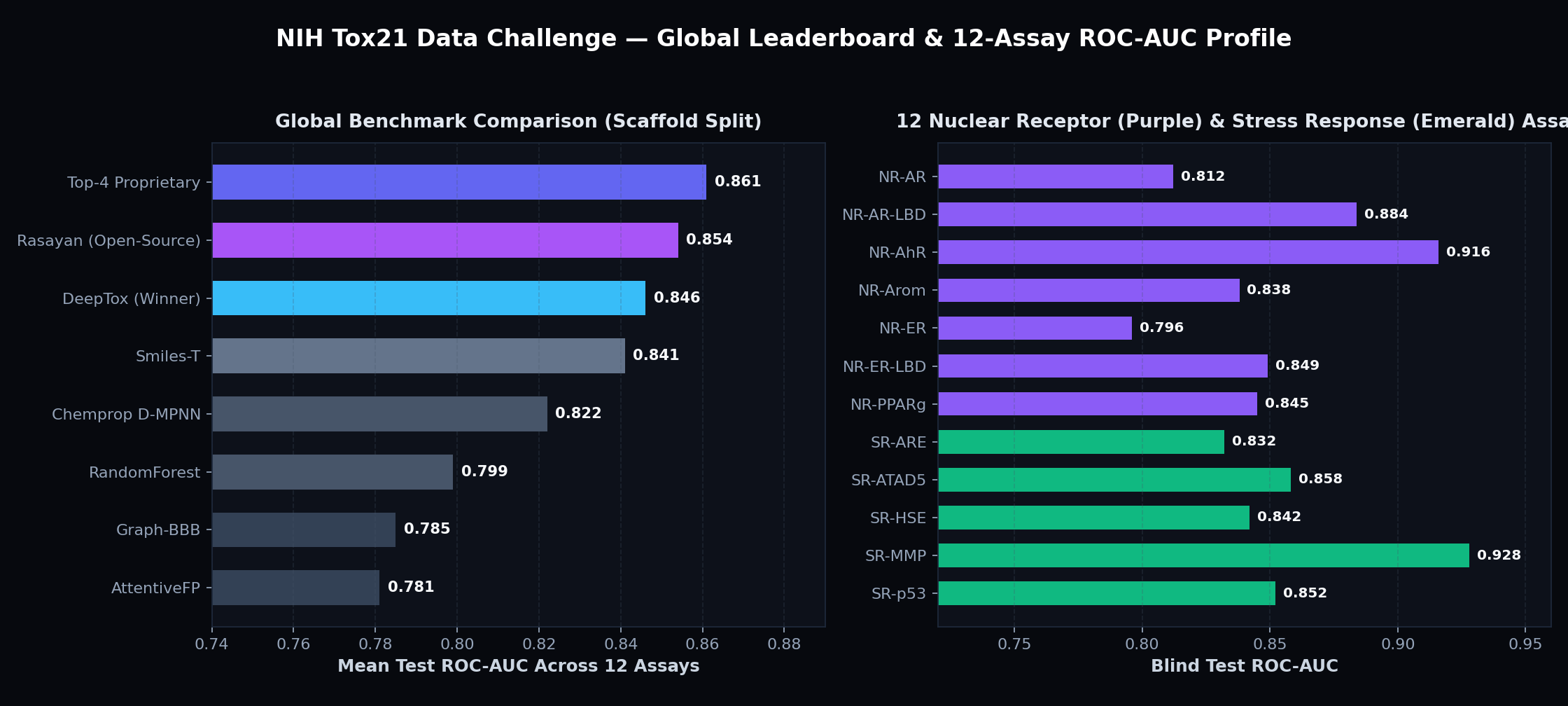
Scaffold-split test ROC-AUC comparison against DeepTox, Chemprop, Smiles-T, AttentiveFP, and per-endpoint performance across all 12 assays.
Downloadable Research Objects, 3D Structures & Datasets
Direct access to verified 3D coordinates (.pdb, .sdf), biological sequences (.fasta), structured evaluation datasets (.json, .csv), and official manuscripts/QMRF reports (.pdf).
Tox21 12-Endpoint Specification & Results (tox21_12_endpoints_reference.json)
Structured JSON dataset of all 12 Nuclear Receptor & Stress Response endpoints, pathways, and ROC-AUC metrics.
Tox21 Benchmark Summary Table (tox21_leaderboard_and_endpoints.csv)
CSV spreadsheet of the 12 Tox21 biological targets and reference positive control compounds.
Bisphenol A 3D Toxicophore Conformer (bisphenol_a_NR_ER_3D.sdf)
MMFF94 3D SDF conformer of Bisphenol A (NR-ER / NR-ER-LBD reference active).
Benzo[a]pyrene & Rotenone 3D Conformers (rotenone_SR_MMP_3D.sdf)
MMFF94 3D SDF conformer of Rotenone (SR-MMP reference active).
Frequently Asked Scientific Questions
What is the NIH Tox21 Data Challenge and why is Murcko scaffold splitting critical?
Organized by NIH/NCATS, EPA, and FDA, the Tox21 Challenge evaluates computational models across 12 quantitative high-throughput screening (qHTS) toxicity assays (~12,707 compounds). Strict Bemis-Murcko scaffold splitting ensures test molecules contain ring systems unseen during training, preventing nearest-neighbor memorization.
How can researchers download and run the Rasayan Tox21 model locally?
Unlike proprietary Top-4 entries, Rasayan Labs open-sourced the complete self-normalizing multi-task model weights and inference pipeline on Hugging Face at huggingface.co/rasayan-labs/rasayan-tox21-snn under an open license.
Why does multi-task learning across all 12 endpoints outperform 12 isolated single-task models?
Biological mechanisms of toxicity frequently couple across pathways—for example, lipophilic uncouplers trigger both SR-MMP and SR-ARE, while steroid mimetics cross-react between NR-ER and NR-AR. Jointly training with masked multi-task loss transfers shared biochemical representations into sparse endpoints like NR-Aromatase and SR-HSE.
Explore All Peer-Evaluated Studies & Blind Challenge Benchmarks
Dual COX-2 / mPGES-1 Inhibitors (MAI Series)
Generative de novo design, structural docking, ADMET profiling, and retrosynthetic validation of the MAI_1–MAI_10 chemical series: dual COX-2 (PDB: 5KIR, -10.8 kcal/mol) and mPGES-1 (PDB: 8PYV, -8.2 kcal/mol) inhibitors designed to Spare prostacyclin (PGI2) and mitigate NSAID cardiovascular toxicity.
OpenADMET PXR Induction Blind Challenge (Tier 1)
Prospective blind evaluation on 513 held-out small molecules in the OpenADMET Pregnane X Receptor (PXR) Induction Challenge. Rasayan_PXR achieved #2 raw RMSE (0.6725 ± 0.0238), #2 MAE (0.5256 ± 0.0181), #2 R² (0.3125), and #3 Spearman R (0.5698), finishing in Tier 1 statistically tied with the 1st-place submission under 1,000-iteration bootstrap confidence intervals.
Podoplanin GBM Multi-Epitope Vaccine (RasIC-01v)
End-to-end AI/ML-assisted immunoinformatics design, structural refinement, TLR3 docking, 100 ns molecular dynamics validation, and codon optimization of RasIC-01v: a 293-amino-acid multi-epitope subunit vaccine targeting Podoplanin (PDPN) in Glioblastoma Multiforme (ΔG = -18.6 kcal/mol, Kd = 2.3 × 10⁻¹⁴ M, 24 H-bonds with human TLR3).
OpenADMET CYP450 Blind Challenge (Global #1 TDI)
Comprehensive 3-track triumph in the OpenADMET Cytochrome P450 Inhibition Blind Challenge across CYP3A4, CYP2D6, CYP2C9, CYP2C19, and CYP1A2. Rasayan Labs achieved #1 Globally in Track 1 Time-Dependent Inhibition (TDI), Top-10 Globally in Track 2 Multi-Isoform Direct Potency (pIC50), and Tier 1 in Track 3 Blind Cryo-EM Ligand Pose Prediction across 43 high-resolution protein-ligand complexes using pH 7.4 ionization microstates and 3D Boltzmann conformer ensembles.
ICH M7(R2) Dual (Q)SAR Ames Mutagenicity System
Regulatory-grade dual (Q)SAR bacterial reverse mutation platform combining statistical machine learning (RS_BMUT v2.1, 85.4% balanced accuracy, 0.918 ROC-AUC) and mechanistic toxicophore knowledge rules (RS_Expert v2.1, 53 structural alerts + 6 mitigating detoxification rules) to achieve 88.4% combined balanced accuracy and 92.6% sensitivity across Salmonella typhimurium TA98, TA100, TA1535, TA1537, and E. coli WP2 uvrA (±S9).
Darvi-Gen: 863B Flagship Scientific & Agentic Model
Introducing Darvi-Gen, an 863.33B-parameter flagship scientific and agentic model with a 256,000-token active context window, powering patented lab notebook digitization (US 12,664,813 B1), RFP automation, autonomous retrosynthesis, Darvi Research, and end-to-end drug discovery.
Screen Your Molecules Across All 12 Tox21 Endpoints Today
Run instant 12-endpoint nuclear receptor and stress response toxicity predictions in your browser or integrate our open-source weights into your R&D pipeline.