
100% Local OCSR, NMR & 3D Conformers
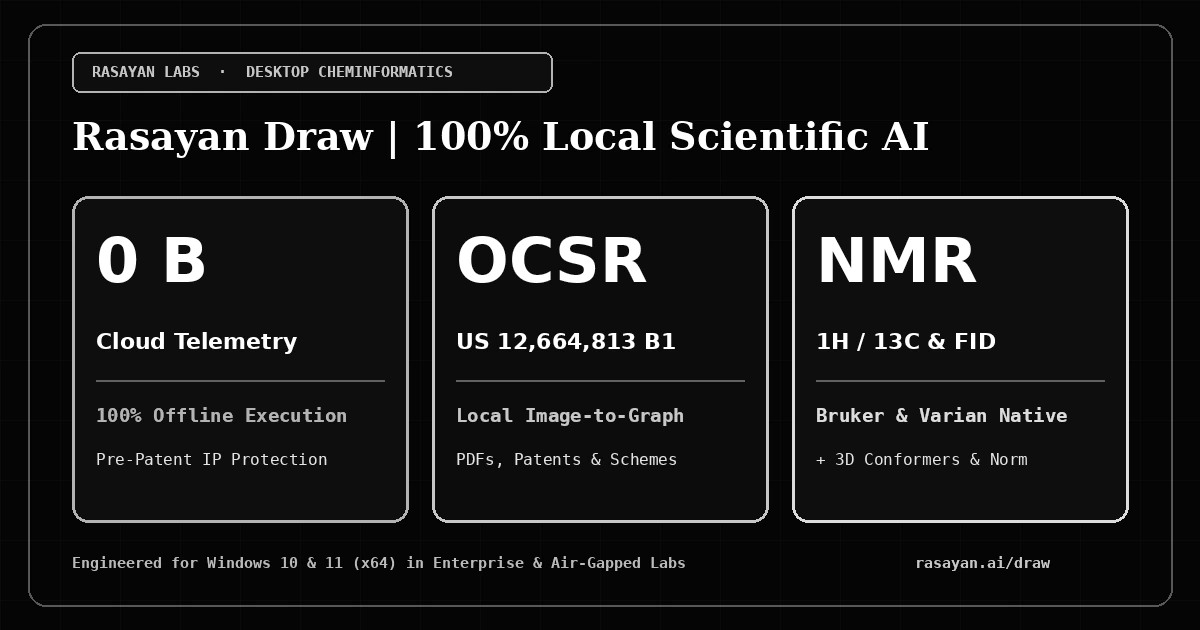
Unifying chemical drawing, patented structure recognition (US 12,664,813 B1), Bruker/Varian FID spectral processing, and multistage Norm Sheets offline on Windows.
In pharmaceutical discovery and process development, an unpublished chemical structure is the core intellectual property of the organization. Before a provisional patent application is filed, corporate security policies strictly prohibit medicinal and process chemists from transmitting novel chemical structures to third-party cloud APIs for IUPAC naming, optical image recognition, or spectral prediction.
At the same time, legacy desktop software forces bench chemists to split their daily work across four or five disconnected applications: a 2D sketcher to draw a reaction scheme, a separate analytical package to process raw Bruker or Agilent/Varian nuclear magnetic resonance (NMR) free induction decay (FID) files, a standalone spreadsheet to calculate multistage stoichiometry, and static screenshots pasted into Word or PowerPoint reports.
We engineered Rasayan Draw for Windows (x64) to bring all of those capabilities into a single native desktop environment where every AI and cheminformatics engine executes 100% locally in workstation memory with zero external network calls.
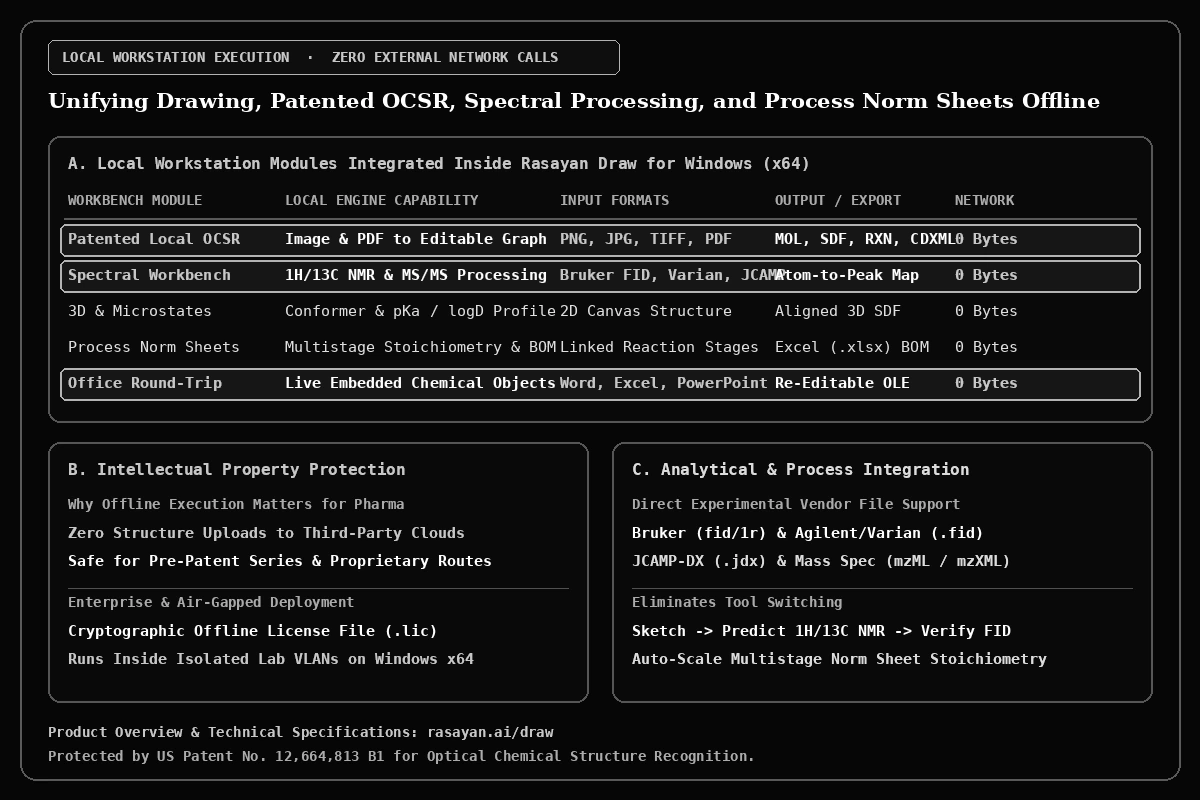
Local Patented OCSR, Spectral FID Processing, and Process Norm Sheets
Using our patented Optical Chemical Structure Recognition engine (granted US Patent No. 12,664,813 B1), a chemist can snip a structure or reaction scheme from a scanned PDF, patent table, or legacy report, inspect the recognized connection table side-by-side with the source image, and place an editable molecular graph directly onto the drawing canvas offline.
Directly beside the drawing canvas, the Spectral Workbench predicts proton (1H) and carbon-13 (13C) NMR chemical shifts, coupling constants (J), and multiplet splitting patterns, or opens experimental Bruker (fid/1r) and Agilent/Varian (.fid) directories, JCAMP-DX spectra, and mzML/mzXML mass-spectrometry files. Clicking any multiplet peak highlights the corresponding atoms on the 2D chemical structure for rapid structural verification.
For process development, the integrated Norm Sheet workspace links consecutive synthesis stages so that changing the target batch scale automatically updates limiting reagents, molar equivalents, and stage mass balances, exporting directly to structured Excel workbooks.
Local Patented OCSR & 12+ Native Chemical File StandardsUS Patent 12,664,813 B1▾
Spectral Workbench (1H/13C NMR, Bruker/Varian FID & Mass Spec)Predicted + Experimental FID▾
3D Conformers, pKa Microspecies & Multistage Process Norm SheetsMedChem & Process Ready▾
How the Offline Workstation Architecture Is Engineered
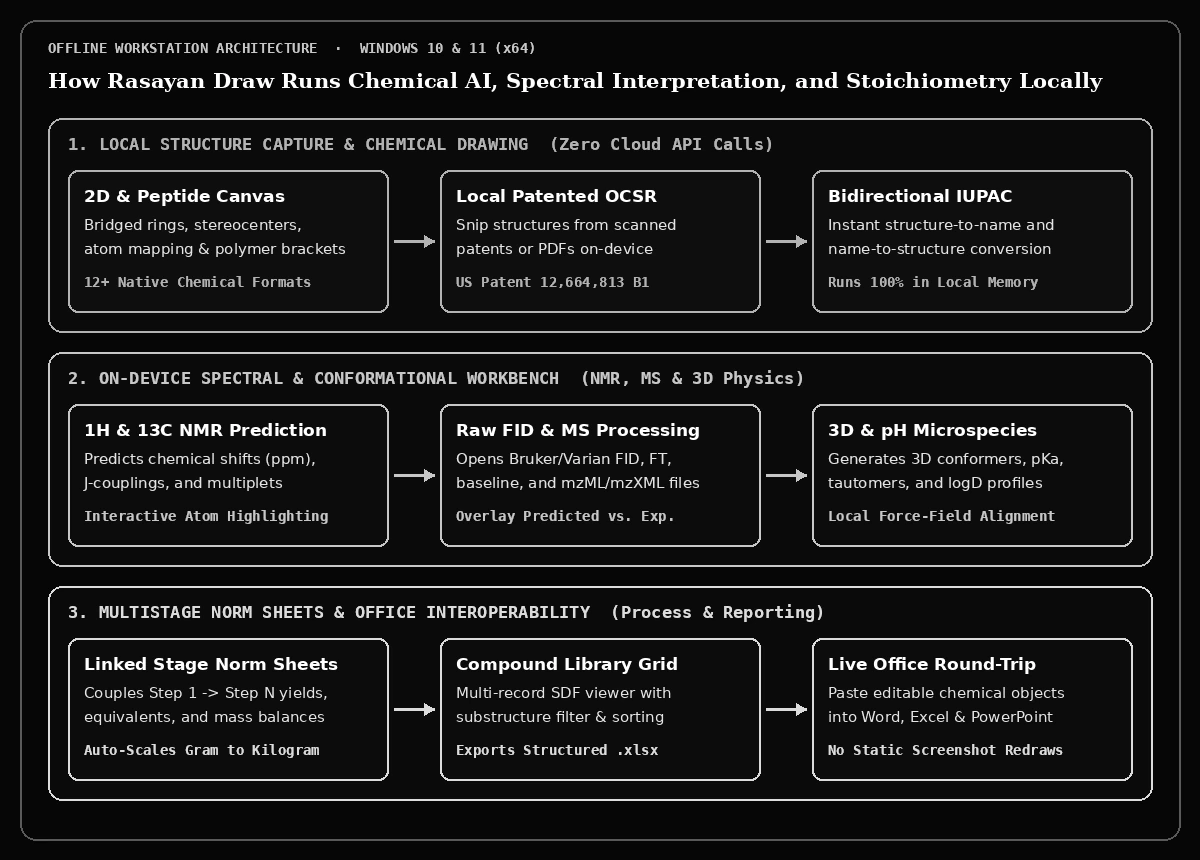
To deliver cloud-grade AI accuracy inside a compact desktop footprint, we compiled our neural OCSR vision models, graph-convolutional NMR shift predictors, and force-field conformer generators into optimized native C++ and ONNX execution graphs that run directly on standard Windows x64 workstations without requiring dedicated data-center GPUs.
What This Means for Medicinal, Process, and Analytical Chemists
When a chemist draws or recognizes a structure in Rasayan Draw, its 3D conformers, pH-dependent protonation states, predicted 1H/13C NMR multiplets, and multistage reaction stoichiometry are available in the same window. And when structures or schemes are pasted into Microsoft Word, Excel, or PowerPoint, they remain live embedded chemical objects that can be double-clicked and re-edited at any time without redrawing from static screenshots.
Explore our technical monographs and documentation, or connect directly with Rasayan Labs.