
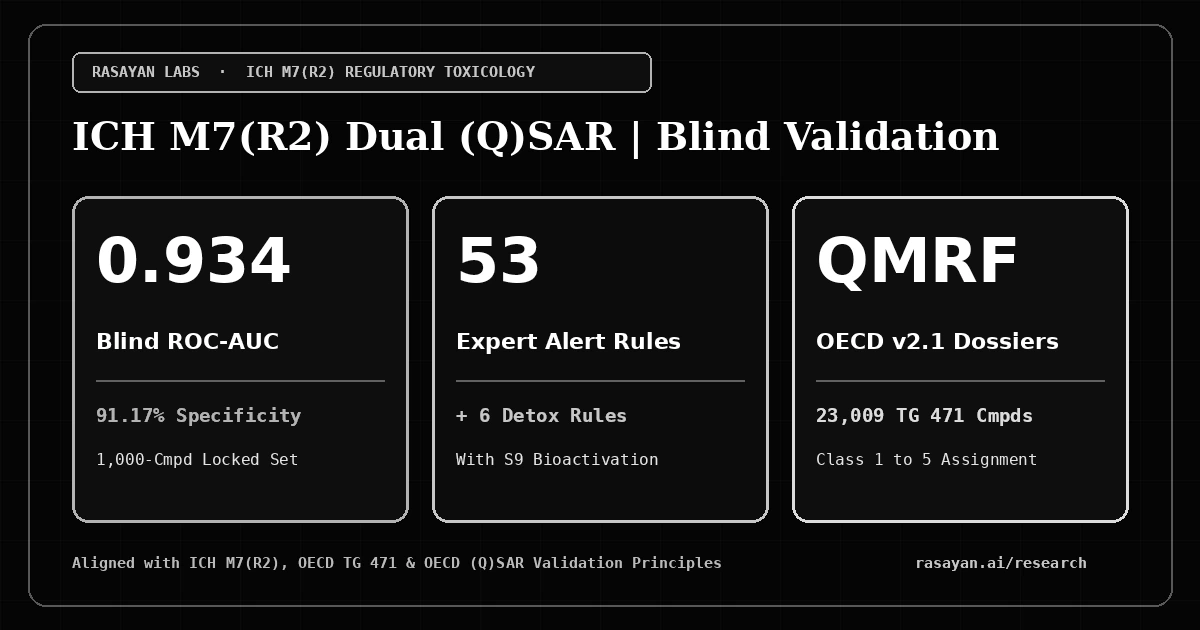
0.9335 Blind ROC-AUC in ICH M7(R2) Dual (Q)SAR
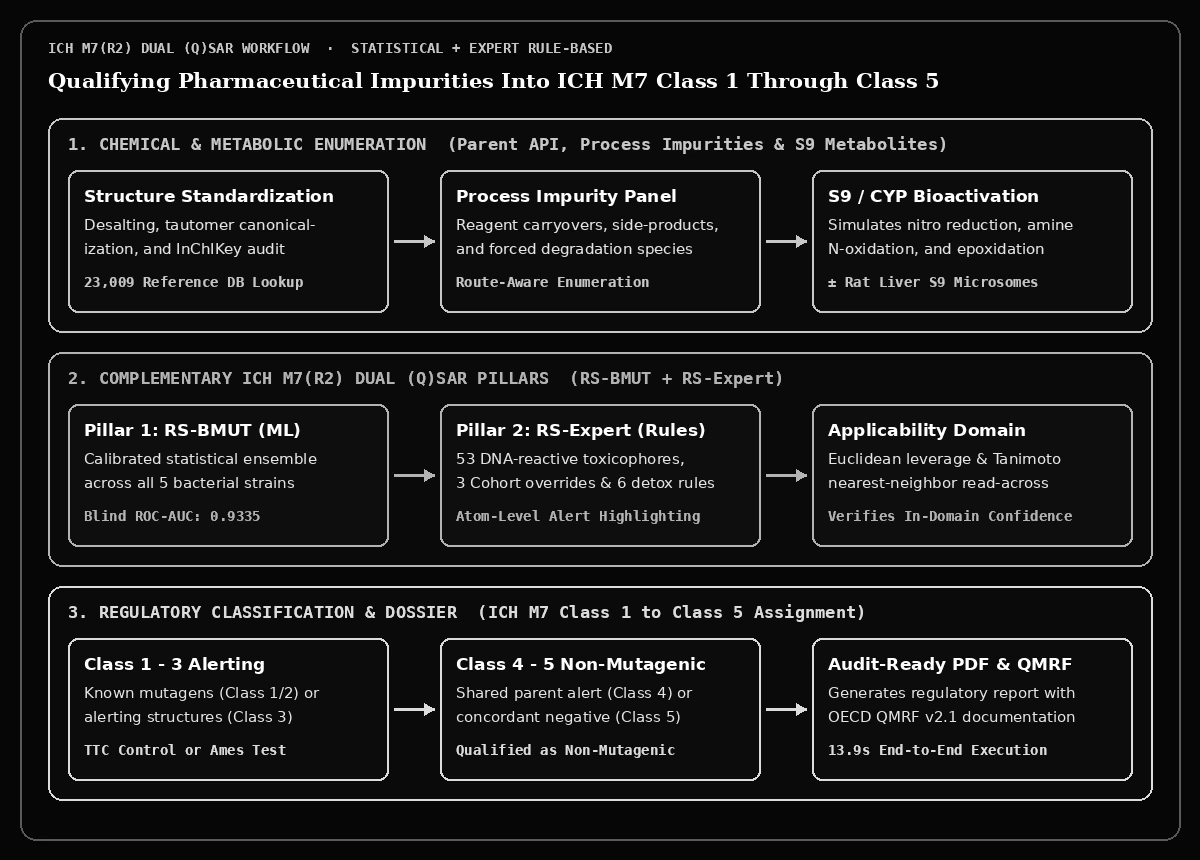
Qualifying pharmaceutical synthesis impurities and S9 metabolites into ICH M7 Class 1 through Class 5 across 23,009 curated OECD TG 471 records.
During active pharmaceutical ingredient (API) route scouting and forced degradation studies, process chemists routinely identify dozens of synthetic intermediates, reagent carryovers, and trace degradants. Determining whether any of those trace impurities can damage DNA and induce bacterial reverse mutations is a mandatory regulatory gate before clinical trial authorizations or commercial manufacturing filings.
Because running wet-lab Good Laboratory Practice (GLP) bacterial reverse mutation assays (OECD Test Guideline 471, the Ames test) on every potential impurity takes weeks, Section 6 of the international ICH M7(R2) guideline permits in silico qualification using two complementary (Q)SAR methodologies: one statistical machine-learning model and one expert rule-based system.
We engineered Rasayan’s ICH M7(R2) Ames Mutagenicity Suite (RS-BMUT and RS-Expert) on a curated corpus of 23,009 unique desalted OECD TG 471 compounds, backed by complete OECD (Q)SAR Model Reporting Format (QMRF v2.1) regulatory dossiers.
Locked 1,000-Compound External Blind Validation and Y-Scrambling Control
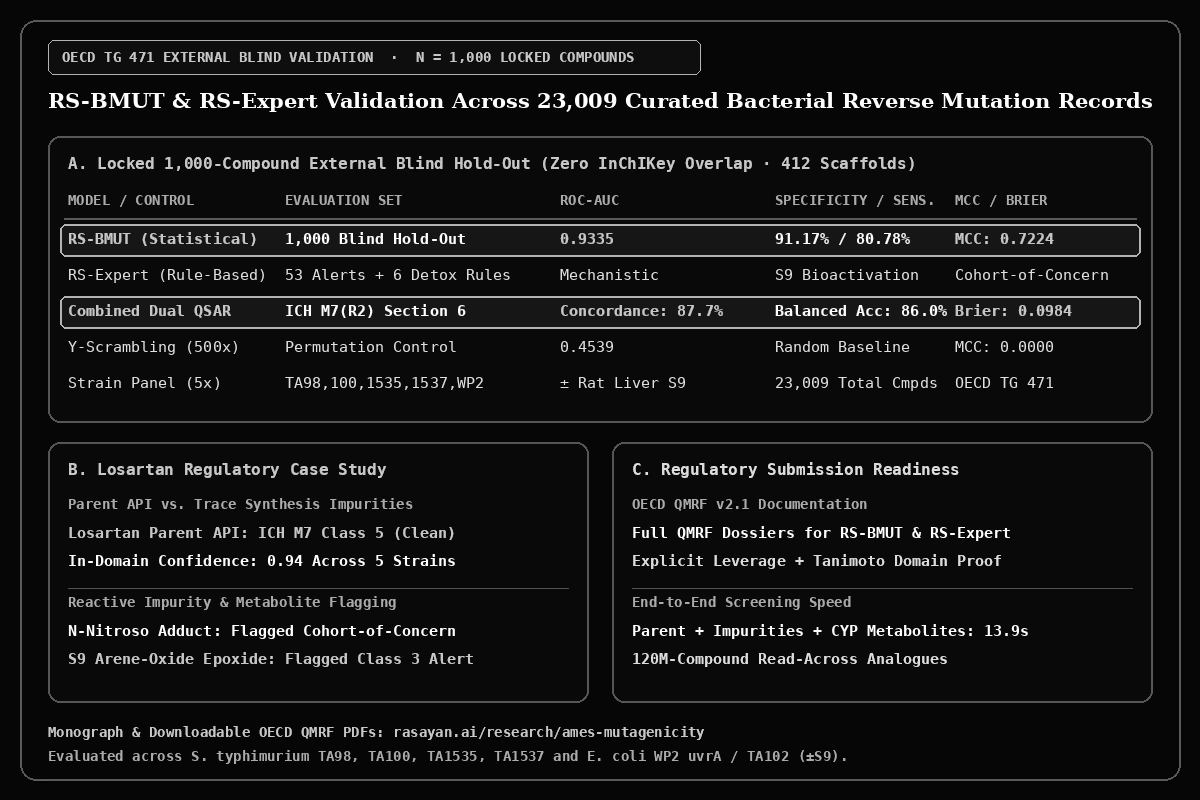
To evaluate generalization rigorously under OECD Validation Principle 4, we partitioned the 23,009-compound reference database into 22,009 training structures and a locked 1,000-compound external blind hold-out spanning 412 Murcko scaffolds with zero InChIKey overlap.
On the 1,000-compound locked external blind set, the statistical pillar (RS-BMUT) achieved a receiver operating characteristic area under the curve (ROC-AUC) of 0.9335 (95% CI: 0.9168 to 0.9482), specificity of 91.17%, sensitivity of 80.78%, overall concordance of 87.70%, Matthews Correlation Coefficient (MCC) of 0.7224, and a calibrated Brier score of 0.0984.
In a 500-iteration Y-scrambling permutation control designed to test for chance correlation or scaffold leakage, model performance collapsed to random baseline (ROC-AUC = 0.4539, MCC = 0.0000), confirming genuine structure-activity learning.
Pillar 1: RS-BMUT Statistical Validation (1,000-Compound Locked Blind Set)ROC-AUC 0.9335 · MCC 0.722▾
Pillar 2: RS-Expert Rule System & Losartan Qualification Case Study53 Alerts + 6 Detox Rules▾
How the Complementary Statistical and Expert Pillars Work Together
Regulatory reviewers at the FDA, EMA, and PMDA require more than a black-box probability score for ICH M7 submissions. They require transparent mechanistic justification, explicit applicability domain boundaries, and nearest-neighbor experimental read-across.
Our dual workflow evaluates every structure across all five OECD TG 471 tester strains (Salmonella typhimurium TA98, TA100, TA1535, TA1537, and Escherichia coli WP2 uvrA / TA102, both with and without rat liver S9 metabolic activation). RS-BMUT computes calibrated strain probabilities alongside Euclidean leverage and Tanimoto similarity domain scores, while RS-Expert audits 53 DNA-reactivity alert classes and 6 detoxifying steric/electronic modulation rules (such as sulfonic acid solubilization or bulky ortho-substitution blocking enzymatic N-hydroxylation).
Audit-Ready Regulatory Reports in 13.9 Seconds
In our published Losartan validation study, the dual system screens the parent biphenyl-tetrazole API, its synthesis intermediates, and its CYP450/S9 metabolites in 13.9 seconds, assigning the parent API to ICH M7 Class 5 (non-mutagenic, 0.94 in-domain confidence) while isolating its trace N-nitroso adduct and S9-generated arene-oxide epoxide metabolite for regulatory control.
Explore our technical monographs and documentation, or connect directly with Rasayan Labs.